Neutrinos travel faster than light

I don't think it is a right question. Quantum tunneling is framed by Heisenberg uncertainity principle and Plank's constant, there is really no speed (light or other) there. However there were some paradoxes cited that appeared to suggest that speed of light was violated when particle was tunneled through the barrier but later this had been resolved.

When I think of the Heisenberg uncertainity principal it makes me think about the properties of light itself. Is it a wave or a particle? Maybe the short answer is "Yes." I wonder though about sine waves and rotation if somehow there is a connection.. IDK Its not even a well thought out hypothesis. Especially because it has an "electric wave" and a "magnetic wave" although they do relate [inversely I think]...

<---<^>--->

Nevermind.. R.C. Jones figured this out in 1941 already.. Jones Calculus I really need to take more math.

<---<^>--->
 
Actually, I have been working for some time now in my garage laboratory on an entirely new type of engine that is completely neutrinos based. So far, my experiments seem promising. When tested against my jeep engine, after almost one hundred experiments, I have found that I can get to the airport in five billionths of a second faster than I would with my standard Jeep engine.

These results have gotten me so excited, I'm thinking of applying for a twenty million dollar grant so that I may continue with my unprecedented research into this new phenomenon.

Considering just the military applications of having all this extra speed, the grant should be a slam dunk.

John
 
I once fixed a nasty intermittent failure problem on one of my former employer's products when I noticed that the push-on jumpers were so easy to remove that I didn't have any confidence that they were actually making contact. After switching to a brand of jumper that had greater insertion force, the problem went away.
 
I was touring the Stanford Linear Accelerator Center. There was a little cutaway of the system with placards explaining the various parts. One read "These rings slow down the particles to nearly the speed of light." Someone had detected the error and had replaced slow down with speed up. That's good, wouldn't want to break any laws.
 
Actually, I have been working for some time now in my garage laboratory on an entirely new type of engine that is completely neutrinos based. So far, my experiments seem promising. When tested against my jeep engine, after almost one hundred experiments, I have found that I can get to the airport in five billionths of a second faster than I would with my standard Jeep engine.

I am planning on rigging up the brake switch to turn on all the lights on the front of the vehicle. All that light going out the front helps deceleration.


Back to the dark sucker theory. Dark is faster than light.
 
Do gravity waves travel at the speed of light?
 
I am planning on rigging up the brake switch to turn on all the lights on the front of the vehicle. All that light going out the front helps deceleration.


Back to the dark sucker theory. Dark is faster than light.

Theory? Natural fact. If dark is the absence of light, in order for dark to exist it has to succumb natural light. Look into a black hole, photons accelerate into blackness.
 
What's a gravity wave?
Could be one of two things. One is defined in fluid dynamice- wave generated at the interface of two fluids (ocean and air is a common example).

The other is gravitational waves, ripples in the curvature of space-time predicted by Einstein in the general relativity theory. I'm guessing PalmPilot meant this one. The upper limit of propagation would then be light speed. I'm not sure any of these waves have actually been detected, such that the measurement is generally accepted by physicists.

What shape would the wave take for a vessel at the speed of light in the first?
 
Could be one of two things. One is defined in fluid dynamice- wave generated at the interface of two fluids (ocean and air is a common example).

They don't need to be at an interface - the only requirement is that the restoring force be gravity.

The other is gravitational waves, ripples in the curvature of space-time predicted by Einstein in the general relativity theory. I'm guessing PalmPilot meant this one. The upper limit of propagation would then be light speed. I'm not sure any of these waves have actually been detected, such that the measurement is generally accepted by physicists.

There's a fairly large experiment (LIGO) that's been looking for them for a while, but there haven't been any big announcements yet. There's pretty good indirect evidence, though: general relativity predicts that two orbiting bodies generate gravitational waves, and the energy in these waves is drawn from the orbits - it's like a kind of drag. In normal situations the effect is completely negligible but for certain extreme cases, like two neutron stars orbiting each other, the spin-down is actually measurable. This has been measured in a few cases, and the observations match the theory extremely well (the 1993 Nobel Prize in Physics was awarded for this work).

And yes, gravitational waves travel at the speed of light.
 
What's a gravity wave?
In general relativity - if you move one body, the information that it was moved will not reach the other body at a distance until some time, this information travels at speed of light and is called gravity wave.
 
Last edited:
Theory? Natural fact. If dark is the absence of light, in order for dark to exist it has to succumb natural light. Look into a black hole, photons accelerate into blackness.
Thus says our resident "scientist" again
 
Theory? Natural fact. If dark is the absence of light, in order for dark to exist it has to succumb natural light. Look into a black hole, photons accelerate into blackness.

Um, actually the Dark Sucker Theory is a cock-n-bull theory created by someone in physics circles in the early to mid 1980's. It made the rounds on Bitnet if anyone remembers what that was.
The closest to accurate I can find/recall without internet hunting for weeks to find it but it looks about right:
http://www.ed-cindy.com/gpage4.html
People have been adding to it and editing and claiming credit for centuries now. I have the original on my old Apple IIe which is over 1000 miles from here at the moment. How times have changed - I use to have my Apple IIe hooked up to Bitnet via a super serial card plugged into the Vax.

The scary bit is that the Dark Sucker Theory makes one heck of a lot of sense way too often.
 
Last edited:
Yeah, I'm still here... The problem is that because the forum engine can't handle ascii properly my screen name winds up different... I used to write code in the bad old days of the late 60's and early 70's in hex... If we wanted a routine the hex interpreter could not parse we would slip in a line or twenty of binary machine instructions - "take that you so and so interpreter."

Anyway, I am gratified to see that Dr. E remains vindicated and that C is unpenetrated (still virginal)... Some of you fellas would be fun to have a few beers with (tea for me) and talk about the frontiers of science - my long gone math skills will not allow me to comprehend the math behind string theory, etc... Being in my 70's I have lived through much of the technological revolution that gives us GPS/Ipads, etc.. I tinkered with radios in the vacuum tube era right after WWII and now we talk about chip masks working in angstroms... I remember buying one of the first consumer transistors in the nineteen fifties, the bright blue, Germanium CK722 - lordy I must have checked and rechecked that circuit a dozen times before I dared to put voltage to it, for fear of blowing the junction... That one transistor cost me two hours of wages at a time in our lives when milk and baby shoes were priority one... I never mentioned to my wife what I paid for it - she would have fainted... Anyway, I would like to be around for another seven decades just to see where technology will go in that time... I hate not knowing (sigh)...

dr. o aka denny-o
 
In general relativity - if you move one body, the information that it was moved will not reach the other body at a distance until some time, this information travels at speed of light and is called gravity wave.

Yes, that's what I had in mind. Thanks.
 
Um, actually the Dark Sucker Theory is a cock-n-bull theory created by someone in physics circles in the early to mid 1980's. It made the rounds on Bitnet if anyone remembers what that was.

Wow Bitnet. That goes back a ways. Next you'll be bringing up FIDONet. ;)
 
No, ARPANet. :D

Heh. Too far back for me.

Well maybe not, but I was too busy on BBS' and running one at the time.

I had a smoking big 10 MB hard drive for storage of downloads. MFM I believe, not RLL.

Some PeeCee guy gave it to me for $5 at a swapfest. The boot sector was bad. Meant it was trash for DOS use.

I took it home, powered it up, and had it running under Microware OS/9 the next day. It knew how to skip bad tracks. DOS at the time was too dumb. Been happily accepting MSFT user's hand me down "obsolete" hardware ever since.

Funniest part was I couldnt afford a case for it, so it sat on the desk (made up of a hollow core door and a couple of bar chairs) for a couple years, running just fine. Same with the four floppy drives scrounged for free. (2 x 5.25", 2 x 3.5").

One of the 5.25" was a full-height floppy drive. Noisy, that bastard was. I made the mistake of putting a popular download file on it one night.

That thing tried to rattle itself around the desk all night while the late-night downloaders or their scripts were calling in.

Ahh. Fun times.
 
No, ARPANet. :D

Yea that. Bitnet, arpanet, nsfnet. Dognet was for the wannabe posers.

"I just posted a message on a bbs, bow down to me."
"Yea so what, we have an orbital mechanics program running on a Cray."
 
Man, I just threw away (finally) my original boxed Wildcat! BBS software disk and manuals, and the same for Turbo Pascal. They'd long been relegated to a shelf in the garage. Now, gone. I ran a BBS in the Seattle area, back when I lusted for enough funds to afford one of those slick curved-cased Gateway computers.
 
Turbo Pascal is cool.
I haven't written a computer program for anything in years however when I do, I default to that since I knew it so well. It'll do a lot including direct access to hardware port addresses. I even built an 8255 IO board with an 8253 timer that I used to bounce a laser off a reflector miles away to measure the speed of light and a bunch of other nonsense that I have absolutely no interest in anymore.

I wonder....oh wow! Somehow even through my major lifestyle change, my Complete Turbo Pascal manual managed to avoid the storage boxes with my college books at my parents house. It's in my only remaining reference shelf which includes my Physics 111/112 book (the other physics books that use to be easy stuff are way too hard for me now) Dang. Even the IBM PC Inside Out manual is there too. That is one seriously useful manual back when I could design stuff out of thin air - it's more useful than a bible is to a church kind of thing. That stuff should be put in storage next time I get a chance.

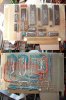
Here ya go: One completely designed from scratch operational IO board from back when computer were real computers: (for your lazy kids that never built anything without a computer designed multi-layer pc board, that colored string looking stuff is called wire wrap wire - you figured out which pinouts did what to make it do what you needed it to do then ran the wires between stuff by hand)
 

Attachments

  • IO8255.JPG
    IO8255.JPG
    165.7 KB · Views: 11
Last edited:
Ugggh. Wirewrap!!! Fun when you have the time. Not fun otherwise.

Oh, come on, it's not that bad. Well, maybe it is now that I haven't done it for a few centuries...but it wasn't bad at the time...or I was too stupid to know it was painful way beyond reason.

In my assorted repair fishing tackle box is 3-4 spools of wire wrap wire. It comes in useful from time to time.

Wire wrapping rules:
1. Always use a wire wrap tool even on solder IC socket posts.
2. Never ever under any conditions let anyone else do the wire wrapping no matter how much they tell you that they can do it or how detailed they are. Translation: Anyone that is not you is completely incompetent. (I had to rebuild a, shall we say, fairly extensive board from scratch once because mr wizard decided the top side diagram of the IC's in the manual were ok to transfer pin to pin without mirror imaging the diagram while looking at the bottom of the board below the IC's, except it was ok to not mirror image only some of the IC's and do the others properly. Fooking idget)
3. Violate #1 or #2 above and you get what you deserve.
 
Last edited:
Four those who are wondering, this is GUMPS for geeks:

http://www.tcpipguide.com/free/t_OSIReferenceModelLayerMnemonics.htm

I haven't heard squat of OSI networking since 1990 or so. Around the late eighties, everybody figured we'd ditch our US Gov't based IP protocols for connectionless ISO. Within a couple of years, the internet took off and nobody gave squat about ISO anymore. The TCP/IP internet protocols while layered don't pay much attention to the model definitions laid out by ISO.
 
I haven't heard squat of OSI networking since 1990 or so. Around the late eighties, everybody figured we'd ditch our US Gov't based IP protocols for connectionless ISO. Within a couple of years, the internet took off and nobody gave squat about ISO anymore. The TCP/IP internet protocols while layered don't pay much attention to the model definitions laid out by ISO.

OSI is alive and well!

TCP/IP certainly pays attention to the layers, particularly the lower and middle layers...take TCP itself...the T is for Transport, which is the layer that TCP operates at in the OSI model. And IP operates at the session layer, and there most certainly is a lot of connectionless traffic over UDP. When I do packet sniffs in Wireshark, it breaks down the packets into their layers nicely.

Lots of network geeks still discuss switches as layer 2 or layer 3 switches, based on whether they operate at the datalink (traditional bridge) or the transport (traditional router) layers.
 
Yeah, I never took the ISO *MODEL* as a dictum by anyone to switch to trying to actually utilize it as a network stack. I'm sure some doofus at DoD attempted it, but it was a model, not a working real-world stack.

Its best use still today is in teaching SOME form of logical troubleshooting flow to newbies, instead of them just thrashing around trying to figure out network problems without a logical model to base their thrashing on.

Then it's just a religious bent as to whether you're a "start at Layer 1" person, or a "start at Layer 7" person. And of course, like all models... it falls apart in some scenarios... but it at least gives a framework for people to communicate while working an issue.

Anyone I've worked with in the last ten years or more would completely understand "Do you think it's a Layer 1 problem?" without hesitation. Wouldn't matter if we were talking about Ethernet, Fiber, tin cans and string... we'd know what they were asking.
 
I make the B version of the cables but the colors don't matter really as long they line up in the patch cable

<---<^>--->
 
I make the B version of the cables but the colors don't matter really as long they line up in the patch cable

<---<^>--->

Good ol' EIA/TIA 568.

Watched a friend cussing while he tore out the hundred pair he'd just punched down to 110 blocks in an old AT&T building with floor to floor risers that were 568A, after he'd punched down for 568B on the distribution 66-blocks. And started over. Old Western Electric building.

Good times. It may not matter at the patch bay with RJ45 connectors much these days, but it matters in the riser closet! ;) ;) ;)

Telco geeks use A... Data geeks use B. Not much A left out there.

Later I learned the stuff put in even earlier, one closet over, was done by a guy who was red/green color-blind -- after I finally went and asked him why so many pairs were crossed up in that room.

I can't tell ya how many T1 CRC and other errors I've fixed by installing shielded twisted pair with one end grounded in T1 service where data geeks used unshielded twisted pair...
 
Another team refuted the OPERA data:
http://www.laboratoryequipment.com/...Neutrinos-Team-Refutes-Prior-Find-031912.aspx

Nobel Prize winning physicist Carlo Rubbia says his team, called ICARUS, used a similar experiment to trap neutrinos fired from the European Organization for Nuclear Research, or CERN, in Switzerland to a detector hundreds of miles away in Italy.
"It's a perfectly straightforward experiment, very clean," Rubbia told The Associated Press in a telephone interview. "The results are very convincing, and they tell us essentially that there was something not quite right with the results of OPERA."
 
Back
Top