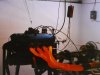
More Heat !!

lockeed

Pre-takeoff checklist
Joined
Jan 18, 2012
Messages
151
Location
Gaspe - Quebec
Display Name
John
Home Airfield
CYGP
Did my first couple winter flights with the RV6 on Thu and Fri. Loved it.

The only downside is I had to get up to 4500-5000ft to get smooth air on friday and it was kind of cold... The heater couldn't produce enough heat to properly warm the cabin. It wasn't unconfortable but I wish I had more heat coming from the heater and less air.

I did some "cold weather prep" to the plane not too long ago which paid off. Like insulating the canopy properly, pluging up the air inlets etc... The cabin is also insulated... But still, it was getting chilly at FL050!

I've looked around to find hints and techniques used by some to get more heat from the heating system, anything new in that department ?

Appart from putting a couple of those on the floor?
redface.gif

redfield_hot_brick.jpg


Apart from the usual heat coming from the exhaust, is there a heating solution which would come from oil, of the actual heat from the engine?

Maybe picking up heat from the oil cooler or something?
 
Thermal underwear.
Flannel lined jeans.
Warm socks.
Boots or shoes, not sneakers.
A wool cap.

No, I'm not being funny. Right now in Denver it's 10F on the ground, I don't even want to think about the temp at 2000-4000 AGL. I can always dress for the flight. I worry more about cold instruments & avionics for the first 15-20 minutes or so of the flight.
 
Apart from the usual heat coming from the exhaust, is there a heating solution which would come from oil, of the actual heat from the engine?

Maybe picking up heat from the oil cooler or something?

I'd be a bit cautious about that, because 1) You don't want to mess with how well the engine can cool its oil, and 2) You don't want to add a failure point that cause an oil leak.

The first point comes into play if you try to add a shroud or something to get heat from the current oil cooler, and both are in-play if you run the hot oil itself through an added heat exchanger.

Our canard friends have been facing this sort of problem for quite a while; you might haunt a few of the canard airplane forums. Often their solution is to add electric heat up by the tootsies. I see Aircraft Spruce has a set of DC-powered heaters:

http://www.aircraftspruce.com/catalog/eppages/heaters242500.php

You might even start thinking about heated seats like the cars have.

Coming from the open-cockpit world, my thoughts usually go toward bundling up. One of our Fly Baby guys has a flight suit that has integrated ducting; he hooks a small hose up to run hot air through his suit.

Ron Wanttaja
 
Instead of pulling cold air from the outside and route it trought the exhaust muff, wouldn't it be better to pick up the air from inside the cabin then simply use an electric fan to push it along? It seams logical that we would get much warmer air, particularely over time as the cabin warm hitself up.
 
Put heat muffs on this exhaust system..:hairraise::hairraise::yikes:
 

Attachments

  • Glowing Headers 002.jpg
    Glowing Headers 002.jpg
    2.6 MB · Views: 16
Apart from the usual heat coming from the exhaust, is there a heating solution which would come from oil, of the actual heat from the engine?

Maybe picking up heat from the oil cooler or something?

The problem with that is that when it is warm outside and your oil temps are 200F, you'll get plenty of heat. When it is 20F outside and your oil temps struggle to reach 150F, there won't be much heat available.
 
Milwaukee tools makes a wonderful heated jacket. Very light, 3 heat ranges, powered by Red lithium battery. Last for 5 - 6 hours. Cost approx. $200.00.

M-12 Cordless Heated Jacket
 
I suspect you'll get your best answers on improving the heating system in an RV-6 from the RV discussion board.
 
I get up to 10K ft and open the window at 0F or below OAT to take photos. It then feels much warmer after I close the window.
 
I suspect you'll get your best answers on improving the heating system in an RV-6 from the RV discussion board.

Already doing that :D

But there's more pilots from the south than from Canada on it...!
 
Last edited:
I'll trade ya. Our bird makes plenty of heat in Winter and too much in Summer.

The heat bypass door won't close all the way and the fiberglass airbox that contains the door mechanism, is riveted to the firewall, making getting to the mechanism to see what's wrong with it, quite a chore.

One of Cessna's dumber design choices. ;)

The door is rubbing on the side of the fiberglass box because the shaft bearings are misaligned. A pain to fix. It's sometimes aggravated by mechanics overtightening the clamp that retains the SCAT hose from the muff. It squashes the fiberglass box and distorts it.

Dan
 
Instead of pulling cold air from the outside and route it trought the exhaust muff, wouldn't it be better to pick up the air from inside the cabin then simply use an electric fan to push it along? It seams logical that we would get much warmer air, particularely over time as the cabin warm hitself up.


That causes a buildup of moisture in the cabin (from breathing and other bodily evaporation) and fogs the windows. Need fresh air passing through. The OP needs to take a good look at his heat muff and see what can be done to get more heat off that exhaust system. There's certainly no lack of it; just need either a bigger section of pipe shrouded, or a better way of forcing more air thought the shroud.

Dan
 
John, in cold country you will need to run two heat muffs. One like you have it now, and one on the other side that feeds the first one. Basically you have a prewarmer. The the warm air then goes through the second heat muff and comes into the cabin nice and roasty.

I have modded 3 or 4 RV's this way. I fly at -10F, -40C?

You will need a new heat muff, scatt tubing, clamps, and a warm hangar. ;)
 
Last edited:
Yep... that's what I'm thinkin'....

What's the best place to get a heat muff and hardware? I don't think Spruce have them...right??
 
I had a Mooney modified with a second heat muff, about 15 years ago. It was one of the last FSDO signed off mods.

The seneca got a "twice as big" heater and a squish out door seal, that puppy is now tight and toasty.
 
Took a look at pictures that I have of my engine... I don't think there is any space to install a secondary heat muff on the other side... there's a support bracket and a sensor attached to the exhaust in the only straight section I have...
 
Took a look at pictures that I have of my engine... I don't think there is any space to install a secondary heat muff on the other side... there's a support bracket and a sensor attached to the exhaust in the only straight section I have...

There should not be any sensors that far away from the exhaust valves. Can you post fhe pictures?
 
I've never had problems getting 'hot' heat from the vents on the -7 - the problem is getting it out from under the instrument panel and into the cabin where it can do more than just cook my feet. I'm usually warmer overall when there isn't someone in the other seat since there is extra room for the hot air to get past my knees. (BTW - I'm speaking of flying in Iowa in the winter, not Georgia like my profile says.)

You might want to try doing some fancy routing with scat tubing to get air routed directly out from under the instrument panel. Geico's suggestion for daisy-chained heat muffs will help as well.
 
John, in cold country you will need to run two heat muffs. One like you have it now, and one on the other side that feeds the first one. Basically you have a prewarmer. The the warm air then goes through the second heat muff and comes into the cabin nice and roasty.

I have modded 3 or 4 RV's this way. I fly at -10F, -40C?

You will need a new heat muff, scatt tubing, clamps, and a warm hangar. ;)

Sounds like you need to move west. That is downright inhospitable. -10 is for penguins. :)
 
Whoa. The EGT probe needs to be a lot closer than that to get the hottest gas reading. I think it is 2-3" from the exhaust flanges, but they should all be the same. You are measuring the flame tip. Lower than that and it is not an accurate reading.

You can move the brace and put the heat muff there. Do not put it over the joint or the egt probe. That will kill you dead. :eek:

Any time to do any work on your heater test for CO. A home model with a 9 volt batteries works well.

Here is a better location for the probes.

http://www.vansairforce.com/community/showthread.php?t=33402&highlight=egt+probe

I would not move them on your plane unless you want to. You will have to weld the hole closed and drill a new one closer to the flange. just know you are not getting peak temp readings.
 
Last edited:
Thx for the info, I'll see what I can do. But it's kind of obvious I have way too much air coming in that 2" inlet....
 
Our King Air 90 had "supercharger heat" along with a Janitrol heater that was a real piece of junk (even when brand new!)
 
I put aluminum tape over the oil pan blast hole.

image


Now I actually have some heat. Not much, but the oil temps are now in better range on frosty days (Coldest so far this year was 17 F)
 
Back
Top