Lower TAS in the summer?

Nikhiln25

Pre-takeoff checklist
Joined
Jan 16, 2024
Messages
307
Display Name
nikhiln25
I bought my plane last fall. This summer is the first time I’m flying it in the summer. It’s 1981 Cessna 182 with a O470U engine. Notoriously bad at fuel distribution.

During the fall, winter and spring months with a 22/23 mp/rpm power setting I was consistently getting high 130s to 140k TAS. More recently since June I’ve consistently been getting 128-132 TAS, with occasional days still getting to the mid to high 130s.

I know engine performance degrades with heat, but curious does this sound normal/do other O470 drivers have a similar discrepancy between normal/cold and hot days? My best guess is the poor distribution on this really takes the efficiency out in the summer, and I probably need to lean more than I normally do to get the same power output
 
Have you done the density altitude calcs to ensure you are comparing apples to apples?
 
Review your PP books for the factors that go into calculating TAS.

Hint, temperature is a factor.

Right.. but higher temp would equal higher TAS at the same IAS right? So why lower in the summer
 
Have you done the density altitude calcs to ensure you are comparing apples to apples?


Density altitude is considerably higher.. 2-3k higher.. so performance lower, but at the same power setting I should be getting same speed? Unless I’m not leaning properly.. I’m going to lean bit more next flight and see what happens
 
Do you have an engine monitor that can help determine whether you are making an equal comparison?

I have an engine monitor but not set up for BHP. That is something I am going to add come this annual.

Reading through the manual, it looks like the O470 1%HP loss for every 6 degrees above standard temp. So at the same power setting when it’s 90 outside I am seeing a big drop in performance at the same power setting. I’m guessing that added with the lift needed to maintain flight in less dense air is leading to a big drop in speed. Though I would still assume it would require more leaning to get to best power and that should add a few kts
 
I wouldn’t think that DA would have a 1:1 direct correlation between engine power and how the airfoil cuts (lifts) through the air. Each airframe and power plant would be different - one engine more or less efficient than the airframe (intuitively). Paging @nauga or any other propeller-head to give the real answer.
 
A given MP/RPM combination will result in consistent horsepower, but less dense air (higher temperature and/or altitude) will make the prop less efficient, resulting in a reduction in thrust.
 
What altitudes are you flying at? For non-turbo planes I always found that 8-9k feet yielded best speeds, so the change in DA due to altitude could swing things a little, but I doubt by 10 knots.

Also, if the plane is new to you, you may mis-remember your initial speeds or they weren't calculated quite right through the fog of getting comfortable with a new plane. I am going through this with a new-to-me plane right now so I can relate. Continuing, per a similar discussion elsewhere, get your airspeed indicator calibrated. I think 140 knots is "optimistic", shall we say, for a non-turbo 182, and your 128-132 knots sounds exactly right on in my experience.

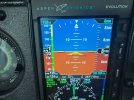
Yup I had calibration done on my aspen recently to correct few errors that were happening. I usually fly 4-6. I have videos of flights from back in the summer where the TAS is decently in the high 130s and when ground speed is inline with that the adsb data also corroborated with that so I don’t think calibration is the issue
 
A given MP/RPM combination will result in consistent horsepower, but less dense air (higher temperature and/or altitude) will make the prop less efficient, resulting in a reduction in thrust.


That makes sense figured that could be the issue as well

Will be very curious to see when fall comes if my speed picks up again
 
I think you are on to something with regard to leaning. Not sure how much of a temperature difference you are talking about, but it could be a couple thousand feet of density altitude difference. How are you leaning? To a fuel flow, EGT ?
 
Manifold pressure and rpm are not the whole shaft horsepower story. Mixture and intake air temperature also will have an effect.

Is your carb heat actually closed?
 
An engine is essentially an air pump. Hotter air is less dense and thus you're pumping less air through on each cycle. Since it's less dense, you've also got less oxygen to work with during the combustion phase. It's the same effect as climbing up through the atmosphere.

I can tell there's more zip in my car engine during cool winter days than on hot days. I can tell the same in my plane.

*true for naturally-aspirated engines. Turbo/supercharged engines are different.
 
I think you are on to something with regard to leaning. Not sure how much of a temperature difference you are talking about, but it could be a couple thousand feet of density altitude difference. How are you leaning? To a fuel flow, EGT ?

It’s now 85/95 every day vs 40-50 in spring. I lean to about 100 rich of peak. But I’ve done it so many times that now I just peak to the number that is 100 about rich of peak without using peak find function. But reality is peak is probably a lot leaner in the summer and I’m probably far more rich than I think I am
 
A given MP/RPM combination will result in consistent horsepower, but less dense air (higher temperature and/or altitude) will make the prop less efficient, resulting in a reduction in thrust.
Thrust is a component of the HP calculation, so that statement is a contradiction.
 
Thrust is a component of the HP calculation, so that statement is a contradiction.
it would be if we were talking about horsepower and thrust from the same component, but we’re talking about horsepower from the engine and thrust from the prop.
 
it would be if we were talking about horsepower and thrust from the same component, but we’re talking about horsepower from the engine and thrust from the prop.
The engine does work by applying force to the propeller. They're not separate.
 
So are you saying an engine would develop less horsepower on a test stand with a club then on an airplane with a propeller?
No, the engine's power is transferred to the dyno, which is designed to absorb the engine's torque in place of a propeller.
 
No, the engine's power is transferred to the dyno, which is designed to absorb the engine's torque in place of a propeller.
And a propeller or test clubabsorbs the engine’s power and converts it to thrust. A variable in that process is air density, and a variable in air density is temperature. Warmer, less dense air will result in less thrust from the same horsepower.
 
And a propeller absorbs the engine’s power and converts it to thrust. A variable in that process is air density, and a variable in air density is temperature. Warmer, less dense air will result in less thrust from the same horsepower.
Reduced air density decreases drag on the propeller which allows it to turn faster, or, with a constant speed prop, at a coarser pitch. Thrust is not "lost" just because air density decreases. You seem to be equating HP to RPM which is not correct.

Reduced air density also reduces drag on airplane, reducing thrust required; this effect is nearly always larger than any loss of propeller efficiency; which is primarily determined by airspeed and the propeller pitch and design characteristics, not the ambient air density.

A Cessna Turbo 182T at 66% power cruises at 150 KTAS at 20,000 feet and ISA+20°C versus 127 TAS at 2,000 feet and ISA-20°C at the same horsepower. If your rubric was correct, it would be slower, not faster.
 
Actually, no, I’m equating HP to a combination of MP and RPM.
If your conclusion is that TAS will decrease, it still not correct for the reasons I described. Blaming OP's loss of TAS on propeller efficiency is not correct. His TAS should be higher at higher DA.
 
Last edited:
The plane's performance chart should have an adjustment factor for air temperature. A given manifold pressure and rpm on days that are 50 degrees different doesn't result in the same power setting. For example, I have a Mooney performance chart saved as it has the same engine as my plane. It states at the bottom to add .4" manifold pressure for every 10 C over standard and to subract .4" for every 10 c below.

So if you were flying in the winter at a certain MP and RPM when it's 20 bellow standard and using the same MP and RPM on a summer day that is 20 above, you are really flying with a mp difference of 1.6". That could certainly account for your performance difference.
 
Generally TAS is a little lower in summer than winter - IAS, the first and dominant factor in calculating TAS for a slow single, decreases due to the less dense air. Turbos may be able to compensate by being able to compress the incoming charge at altitude, depending on temperature limits. Jets suffer the same limitations, performing worse at high ISA. They too are normally aspirated.
 
Was able to get high 130/140 today on the same 22/23 power setting on a well above ISA day with more aggressive leaning
 

Attachments

  • IMG_0735.jpeg
    IMG_0735.jpeg
    2.9 MB · Views: 12
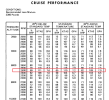
A cruise chart for the 172M:

1753583524418.png

For example, at 6000 feet and 2500 RPM, we get 69% power and 111 knots at 20°C below standard temperature for that altitude. At standard temperature, we get 65% power and 110 knots. At 20°C above standard, we get 62% and 109 knots. Note that the fuel burn also decreases with the higher temps.

Which makes it obvious: the speed is less at higher temps because the horses are fewer because the air's density is lower, and with the mixture adjusted to "lean" as Cessna calls it, less fuel flows to make the air/fuel mixture ratio the same.
 
The above is all good discussion. I’ve also wondered about this with my Warrior. And I wonder if high atmospheric pressure has anything to do with it, since atmospheric highs tend to have sinking air.
 
At the same % power, your 182 should be faster in warmer temperatures.

This. Post #2 mentioned comparing apples to apples.
The 6K 2500 rpm example above does make sense. Comparing the same -RPM- across 20 below std, std and 20 above std makes sense that -HP- would decrease and therefore TAS.

Look at 6K and 2300 rpm. At 20 below std, 56% -HP- resulting in 100 kts. Now jump over to 20 above std. I can get 56% -HP- by spinning the prop faster to 2400 rpm. Thinner air? Need to sling the prop faster to catch it. Same fuel burn, but 103 kts.

So, for a given -HP-, TAS will increase with higher density altitude. Think about swimming as hard as you can in molasses compared to water. Same work output would result in different true speed through the given liquid.


Sent from my iPhone using Tapatalk
 
Back
Top