Less fuel flow & no rpm rise at idle cut-off with new carburetor

bkspero

Line Up and Wait
Joined
Mar 5, 2012
Messages
652
Display Name
bkspero
The carburetor in my Tiger (O-360-A4K) was replaced with a factory overhauled carb and it seems to be running leaner than the old one was. The max fuel flow in take-off from essentially sea level, full throttle, full rich is about 15 gph where it was about 16.5 before. Taxiing when warm and leaned is using about 1.4 gph of fuel where it used to use about 2.2 gph. And the idle mixture seems leaner as there is no longer a small rpm rise when pulling the mixture to shut down the engine.

All those things said, the engine is running fine. EGT/CHT's seem similar to what they were. There is no roughness during idle. Full throttle static runup rpm is well in spec (about the 75th percentile of the spec range). Lycoming's minimum fuel flow graph for the O-360 shows a minimum fuel flow of about 14.9 gph at 100% power at sea level, so the fuel flow I'm seeing meets that requirement (but just barely).

So, my inclination is to leave well enough alone unless there is something of which I am unaware that could be a problem. Like maybe a change when the weather heats up from recent cold weather (20-40 deg F) to the summer (100 F).

The shop is telling me that all is fine. But in the spirit of "Trust but verify", I'm asking here: "Is there anything here worth looking into?
 
I got a overhauled carburetor a couple months back and I don't get a rise after cut off. We played with the idle mixture screw until we were blue in the face and no rise.
 
If you dial it in just right in winter, you may find that it's not quite right in summer, or vice versa.

Runs smooth? EGT/CHT ok? Makes spec static RPM? Doesn't stumble when you give it gas on the takeoff roll in winter? Fuggedaboutit.
 
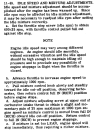
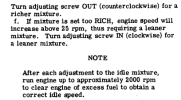
Idle mixture checks are often incorrectly done at idle. But if we read the manuals we see something different. For example, this is from a C182 manual:

1740591821917.png
1740591843595.png

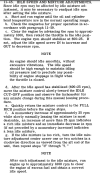
Look at that: 1000 RPM is the test RPM, not a full idle of 600. And the RPM rise is tiny. This is for the 230-HP O-470. Below is the data from a 172 manual, for a 150-HP O-320. It's pretty much the same, except that the mixture check is done at full idle. So the manual for that Tiger must be consulted to see what is required. The different models of carburetor make the difference.

1740592126095.png
 
Last edited:
Idle mixture checks are often incorrectly done at idle. But if we read the manuals we see something different. For example, this is from a C182 manual:


Look at that: 1000 RPM is the test RPM, not a full idle of 600. And the RPM rise is tiny. This is for the 230-HP O-470. Below is the data from a 172 manual, for a 150-HP O-320. It's pretty much the same, except that the mixture check is done at full idle. So the manual for that Tiger must be consulted to see what is required. The different models of carburetor make the difference.
Thanks for the input. Sorry that it's taken this long for me to respond, but I couldn't get around to digging out and through the manual until today. The Tiger (AA5B) maintenance manual calls for the mixture test to be done warmed up at idle rpm as I've been doing it. So incorrect test method doesn't seem to be an issue.

By the measure of that test, the plane's idle mixture is too lean. But it idles just fine. And I don't see any other downside to a lean idle mixture other than the potential to idle poorly (which it doesn't do). So for now I will continue to fly the plane as it is, and have the shop address any problem symptoms if/when they show up.
 
So your new factory-overhauled carb is running more efficiently than your, presumably, old busted-ass carb. I must be missing something because that doesn't seem like a problem to me.
 
Last edited:
And I don't see any other downside to a lean idle mixture other than the potential to idle poorly (which it doesn't do).

I must be missing something because that doesn't seem like a problem to me.
It can become a problem. When setting idle mixture, the mechanic needs to take into account where that airplane lives and where it is likely to go. If he sets that mixture so that he get the 25-RPM rise on a nice warm or even hot day, and then winter comes and the temperature drops to below zero, the engine might not run at idle at all. Might quit on approach at idle. The much-increased air density in winter means that the mixture will be much too lean, since the mixture flow depends on the air velocity past the gap between the throttle plate and carb bore wall. Air density doesn't change the flow, unfortunately, and it's why we have mixture controls in the first place.

Or the mechanic in Denver (or worse, in Leadville) sets the mix to get the 25-RPM drop, then the pilot flies to LAX, the engine quits for the same reason.
 
A final check on this is if the engine accelerates smoothly from idle.

Hesitation or popping is generally too Lean.

Carb Heat ON effectively richens the mixture and may point out a

need for adjustment.
 
It can become a problem. When setting idle mixture, the mechanic needs to take into account where that airplane lives and where it is likely to go. If he sets that mixture so that he get the 25-RPM rise on a nice warm or even hot day, and then winter comes and the temperature drops to below zero, the engine might not run at idle at all. Might quit on approach at idle. The much-increased air density in winter means that the mixture will be much too lean, since the mixture flow depends on the air velocity past the gap between the throttle plate and carb bore wall. Air density doesn't change the flow, unfortunately, and it's why we have mixture controls in the first place.

Or the mechanic in Denver (or worse, in Leadville) sets the mix to get the 25-RPM drop, then the pilot flies to LAX, the engine quits for the same reason.
I had considered the possible impact of changing seasons in deciding to leave well enough alone. The carb was set up and tested in the depth of winter, so the mixture will get richer in warmer weather.

Same thing for the elevation effect. My home base where the work was done and where the tests were conducted is near sea level. So flying to another airport can only have a similar or higher elevation (no plans to fly to Death Valley<G>). That would make the idle mixture either unchanged or richer.
 
Back
Top