Kenny Phillips
Final Approach
- Joined
- Jul 29, 2018
- Messages
- 6,570
- Display Name
- Kenny Phillips


Fortunately no fatalities as of yet. All 10 pax + 1 crew accounted for. One person reported critical condition.OMG that's terrible. RIP.


Unknown what was the cause, but the plane did turn around sharply, heading away from the thunderstorm that was going over Orcas. The attempted landing looked stable until the last few feet, as if there was a late decision to go around or change the landing zone.Just checked the time of incident (reported by the news anyway) against texts from my dad last night. May or may not have any bearing on the incident, but he was reporting lightning directly in front of his place on Orcas (next island to the south of Sucia) followed by very heavy rain, just a couple minutes prior to the reported incident time.

Landing in Canada is an issue, without paperwork. Flying across the border is a non-event. Even so, it's just paperwork if you do need to land.What kind of issues would arise from crossing the border in an attempt to make a precautionary (or emergency, given any other potential factors) landing?

There's gotta be a lot more to the story. Float planes don't just crash into the beach, catch fire and explode. Lots of questions on this one. We're just gonna have to wait and see. Maybe the preliminary report will shed some light on what happened.Unknown what was the cause, but the plane did turn around sharply, heading away from the thunderstorm that was going over Orcas. The attempted landing looked stable until the last few feet, as if there was a late decision to go around or change the landing zone.
I’ve never flown a seaplane, and with the understanding that decisions to land there could have come from any number of reasons, I’m curious about precautionary landings ahead of severe weather. If caught out by weather, with no way to get around it, we landlubbing aviators usually look to divert to an airport downwind or laterally, away from the storm. What’s the decision chain when it comes to seaplanes? It feels like you have might have more options over water, but not all of them are good, right?
I’m also considering Canadian airspace and how that can influence decision-making. The way the line of storms was moving toward them kind of hemmed them in, putting them in a corner. By the time they made the westward turn inbound, their only avenue of escape would have been to Vancouver. What kind of issues would arise from crossing the border in an attempt to make a precautionary (or emergency, given any other potential factors) landing?
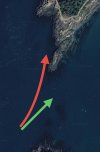
From the video, it almost looked like they were lined up near the green path and for whatever reason turned to the red path. Maybe turned north a little farther out than what I illustrated.There's gotta be a lot more to the story. Float planes don't just crash into the beach, catch fire and explode. Lots of questions on this one. We're just gonna have to wait and see. Maybe the preliminary report will shed some light on what happened.


what's with the thumbs down somebody doesn't appreciate a historic aircraft that's been through a battle in it's life and provided tens of thousands of flying time? what's not appropriate about it in this thread about the aircraft?a little information about that particular otter
The airframe of N709KA (Manufacturer Serial Number 410) has a deeply documented 66-year history spanning military operations, wilderness bush flying across northern Canada, and scheduled airline service in Washington. [1, 2]
Complete Registration & Owner History
The detailed chain of custody and regional deployments for this specific airframe includes the following milestones: [1, 2]
Prior to its sale to Kenmore Air in July 2016, the aircraft was publicly listed by broker C&S Enterprises with an asking price of US$995,000. [1]
- 1960–1967 (Military Service): Delivered to the Royal Canadian Air Force (RCAF) on December 30, 1960, under military serial number 9427. It was primarily operated by No. 438 Air Reserve Squadron out of CFB St. Hubert in Quebec. It survived a landing incident there on February 13, 1965.
- 1967–1975 (The Canadian Bush): Rebuilt and registered as bush plane CF-VVY by Northward Aviation Ltd. in Edmonton, working out of Yellowknife, Northwest Territories.
- 1975–1989 (Eastern Canada Transport): Acquired by Northern Wings Ltd. (Les Ailes du Nord), based out of Sept-Îles, Quebec, and later re-registered under Canada's updated civil system as C-FYYV. It subsequently flew for Air Fecteau and Propair Inc., surviving another minor landing incident in the trees at Rivière Macho, QC, in 1989.
- 1999–2008 (Turbine Era Conversion): Purchased by Big River Air Ltd. in Fort Smith, Northwest Territories. During the winter of 1999/2000, they officially converted the airframe from its original radial piston configuration into a high-performance Vazar Turbine Otter. It was later briefly leased to Air Wemindji.
- 2008–2016 (Quebec Airline Fleet): Transferred to Air Roberval Ltée in Roberval, Quebec, continuing its northern utility flight operations.
- 2016–2026 (Pacific Northwest Operations): Imported into the United States and registered to Kenmore Air Harbor LLC on July 25, 2016, as N709KA. It flew thousands of flight hours over Puget Sound and the San Juan Islands until its retirement via the water landing on July 23, 20
While the exact final negotiated contract price between Air Roberval and Kenmore Air remains confidential corporate data, the listing records from the DHC-3 Archive outline the aircraft's configuration at the time of the transaction: [1]
2015/2016 Sale Listing Highlights
For comparison, a fully modernized, turn-key Viking/de Havilland DHC-3 Turbine Otter in today's market typically commands an average pre-owned value of around $1,500,000 depending on its structural cycle limits and remaining engine hours. [1]
- Asking Price: $995,000 USD
- Total Airframe Hours: 24,580 hours at the time of listing (clarifying its multi-decade history)
- Engine Type: Pratt & Whitney PT6A-34 Turbine
- Equipment Included: EDO 7170 stretched floats, a BARON STOL (Short Take-Off and Landing) performance modification kit, and separate wheel landing gear [1]

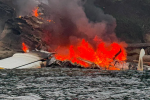
Airplane hit rocks. Fuel tanks breached by impact. Passengers evacuated. Fuel vapors ignited by turbine engine(s) or electrical sparking. Plane burned.There's gotta be a lot more to the story. Float planes don't just crash into the beach, catch fire and explode. Lots of questions on this one. We're just gonna have to wait and see. Maybe the preliminary report will shed some light on what happened.
Actually, I think Juan Brown probably answered my questions when he talked about "boating activity" in the vicinity of the intended landing. I hadn't even thought of that. I'd still think we aren't going to know what was really going on until the FAA reveals what the pilot's explanation is. Just for point of reference, post crash fires occur in fewer than 10% of all GA crashes according to NTSB data. I'm sure the low-angle impact and collision with the rocks contributed to the breach of the fuel system. It'll be interesting to find out what emergency procedures the pilot was able to complete before the impact.Airplane hit rocks. Fuel tanks breached by impact. Passengers evacuated. Fuel vapors ignited by turbine engine(s) or electrical sparking. Plane burned.
Yeah, that bay is quite tiny, just a few boats would mess up any landing path. It does appear that the pilot was committed to putting it down, one way or another.Juan Browne (Bancolario on YouTube) SP? Speculated it might have been boat traffic in the bay where the Pilot was first headed.