This is a great forward. Thank you Dfc. Watch and read the text and see the great pictures, when you have 20 minutes to spare. KB....
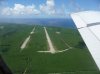
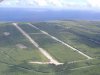
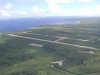
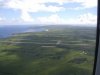
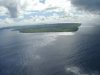
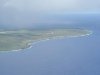
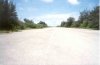
From the pictures it is obvious why Tinian was selected for the B-29 base, look how flat it is.
I wish the person that visited and took these pictures had identified himself.
Don't know who the author is, but this is some fascinating history you probably didn't study in school. Be sure to read to the end!
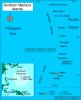
Tinian Island, Pacific Ocean.
It's a small island, less than 40 square miles, a flat green dot in the vastness of Pacific blue.
Fly over it and you notice a slash across its north end of uninhabited bush, a long thin line that looks like an overgrown dirt runway.
If you didn't know what it was, you wouldn't give it a second glance out your airplane window.
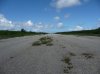
On the ground, you see the runway isn't dirt but tarmac and crushed limestone, abandoned with weeds sticking out of it. Yet this is arguably the most historical airstrip on earth. This is where World War II was won. This is Runway Able:
Aerial view east-southeast of the North Field area of Tinian Island. Runway Able is on the left and Runway Baker is on the right. From here in August 1945,
the B-29 bombers Enola Gay and Bockscar launched their atomic attacks on Japan. The eastern aircraft parking pad is flanked by the former Japanese Air Operations Building to the east and air raid shelters to the west. The former Japanese Air Administration Building is rising above the jungle to the north of this pad.
Aerial view southeast of the North Field area. The heart-shaped pad is where personnel from the 509th Composite Group loaded atomic bombs into the B-29s. Bomb loading Pit #1 (for Little Boy) is the dot in the left lobe and Pit #2 (for Fat Man) is the dot in the right lobe.
Aerial view south of the North Field area.
Another aerial view south of the North Field area.
Aerial view northwest of the North Field area.
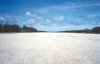
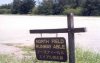
View west along Runway Able.
View east along Runway Baker.
Runway Able.
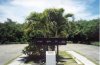
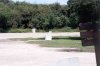
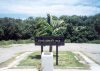
View west of the atomic bomb loading pits, now filled in. The monument for Pit #1 is closest to the camera in the foreground.
Pit #2 is marked by the monument located farthest from the camera.
View of atomic bomb loading Pit #1. The plaque on the monument reads "From this loading pit the first atomic bomb ever to be used in combat
was loaded aboard a B-29 aircraft and dropped on Hiroshima, Japan, August 6, 1945. The bomber, piloted by Colonel Paul W. Tibbets, Jr., USAAF,
of the 509th Composite Group, Twentieth Air Force, United States Army Air Forces, was loaded late in the afternoon of August 6, 1945 and at 0245
the following morning took off on its mission. Captain William S. Parsons, USN, was aboard as weaponeer."
View of atomic bomb loading Pit #2. The plaque on the monument reads "From this loading pit the second atomic bomb ever to be used in combat was loaded aboard a B-29 aircraft and dropped on Nagasaki, Japan, August 9, 1945. The bomber was piloted by Major Charles W. Sweeny, USAAF, of the 509th Composite Group, Twentieth Air Force, United States Army Air Forces. On August 10, 1945 at 0300, the Japanese Emperor without his cabinet's consent decided to end the Pacific War."
On July 24, 1944, 30,000 US Marines landed on the beaches of Tinian. Eight days later, over 8,000 of the 8,800 Japanese soldiers on the island were dead (vs. 328 Marines), and four months later the Seabees had built the busiest airfield of WWII - dubbed North Field - enabling B-29 Superfortresses to launch air attacks on the Philippines, Okinawa, and mainland Japan.
Late in the afternoon of August 5, 1945, a B-29 was maneuvered over a bomb loading pit, then after lengthy preparations, taxied to the east end of North Field's main runway, Runway Able, and at 2:45am in the early morning darkness of August 6, took off.
The B-29 was piloted by Col. Paul Tibbets of the US Army Air Force, who had named the plane after his mother, Enola Gay. The crew named the bomb they were carrying Little Boy. 61®2 hours later at 8:15am Japan time, the first atomic bomb was dropped on Hiroshima.
Three days later, in the pre-dawn hours of August 9, a B-29 named Bockscar (a pun on "boxcar" after its flight commander Capt. Fred Bock), piloted by Major Charles Sweeney took off from Runway Able. Finding its primary target of Kokura obscured by clouds, Sweeney proceeded to the secondary target of Nagasaki , over which, at 11:01am, bombardier Kermit Beahan released the atomic bomb dubbed Fat Man.
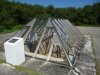
Here is "Atomic Bomb Pit #1" where Little Boy was loaded onto Enola Gay:
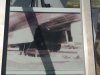
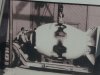
There are pictures displayed in the pit, now glass-enclosed. This one shows Little Boy being hoisted into Enola Gay's bomb bay.
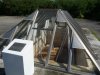
And here on the other side of ramp is "Atomic Bomb Pit #2" where Fat Man was loaded onto Bockscar.
The commemorative plaque records that 16 hours after the nuking of Nagasaki, "On August 10, 1945 at 0300, the Japanese Emperor without his cabinet's consent decided to end the Pacific War."
Take a good look at these pictures, folks. This is where World War II ended with total victory of America over Japan. I was there all alone. There were no other visitors and no one lives anywhere near for miles. Visiting the Bomb Pits, walking along deserted Runway Able in solitude, was a moment of extraordinarily powerful solemnity.
It was a moment of deep reflection. Most people, when they think of Hiroshima and Nagasaki, reflect on the numbers of lives killed in the nuclear blasts - at least 70,000 and 50,000 respectively. Being here caused me to reflect on the number of lives saved - how many more Japanese and Americans would have died in a continuation of the war had the nukes not been dropped.
Yet that was not all. It's not just that the nukes obviated the US invasion of Japan, Operation Downfall that would have caused upwards of a million American and Japanese deaths or more. It's that nuking Hiroshima and Nagasaki were of extraordinary humanitarian benefit to the nation and people of Japan.
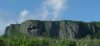
Let's go to this cliff on the nearby island of Saipan to learn why:
Saipan is less than a mile north of Tinian ... The month before the Marines took Tinian, on June 15, 1944, 71,000 Marines landed on Saipan. They faced 31,000 Japanese soldiers determined not to surrender.
Japan had colonized Saipan after World War I and turned the island into a giant sugar cane plantation. By the time of the Marine invasion, in addition to the 31,000 entrenched soldiers, some 25,000 Japanese settlers were living on Saipan, plus thousands more Okinawans, Koreans, and native islanders brutalized as slaves to cut the sugar cane.
There were also one or two thousand Korean "comfort women" (kanji in Japanese), abducted young women from Japan 's colony of Korea to service the Japanese soldiers as sex slaves. (See The Comfort Women: Japan 's Brutal Regime of Enforced Prostitution in the Second World War, by George Hicks.)
Within a week of their landing, the Marines set up a civilian prisoner encampment that quickly attracted a couple thousand Japanese and others wanting US food and protection. When word of this reached Emperor Hirohito - who contrary to the myth was in full charge of the war - he became alarmed that radio interviews of the well-treated prisoners broadcast to Japan would subvert his people's will to fight.
As meticulously documented by historian Herbert Bix in Hirohito and the Making of Modern Japan, the Emperor issued an order for all Japanese civilians on Saipan to commit suicide. The order included the promise that, although the civilians were of low caste, their suicide would grant them a status in heaven equal to those honored soldiers who died in combat for their Emperor.
And that is why the precipice in the picture above is known as Suicide Cliff, off which over 20,000 Japanese civilians jumped to their deaths to comply with their fascist emperor's desire - mothers flinging their babies off the cliff first or in their arms as they jumped.
Anyone reluctant or refused, such as the Okinawan or Korean slaves, were shoved off at gunpoint by the Jap soldiers. Then the soldiers themselves proceeded to hurl themselves into the ocean to drown off a sea cliff afterwards called Banzai Cliff. Of the 31,000 Japanese soldiers on Saipan, the Marines killed 25,000, 5,000 jumped off Banzai Cliff, and only the remaining thousand were taken prisoner.
The extent of this demented fanaticism is very hard for any civilized mind to fathom - especially when it is devoted not to anything noble but barbarian evil instead. The vast brutalities inflicted by the Japanese on their conquered and colonized peoples of China, Korea, the Philippines, and throughout their
"Greater East Asia Co-Prosperity Sphere" was a hideously depraved horror.
And they were willing to fight to the death to defend it. So they had to be nuked. The only way to put an end to the Japanese barbarian horror was unimaginably colossal destruction against which they had no defense whatever. Nuking Japan was not a matter of justice, revenge, or it getting what it deserved. It was the only way to end the Japanese dementia.
And it worked - for the Japanese. They stopped being barbarians and started being civilized. They achieved more prosperity - and peace - than they ever knew, or could have achieved had they continued fighting and not been nuked. The shock of getting nuked is responsible.
We achieved this because we were determined to achieve victory. Victory without apologies. Despite perennial liberal demands we do so, America and its government has never apologized for nuking Japan. Hopefully, America never will.
Oh, yes... Guinness lists Saipan as having the best, most equitable, weather in the world.
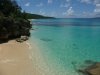
And the beaches? Well, take a look:



 , and of course that's the scene that started this genre of story. We were rolling with that at the movies...