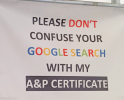
Interesting AI hallucination

flyingron

I am not the Ari
Management Council Member
Joined
Jul 31, 2007
Messages
26,930
Location
Catawba, NC
Display Name
FlyingRon
Home Airfield
NC26
I was wondering today (based on a maintenance forum question on 182s) if there were any O-470s with splined shafts. Google's AI seems to have hallucinated a GO-470 engine with a splined shaft that was used on Cessna 210s. There's no such engine, and the 210s always had direct-drive injected Continentals. There was a GIO-470, but it seems rather rare, and the only reference I can find for it is on the Beagle Basset B.206. Doesn't seem to have a US type certificate, the Basset used a Rolls Royce version. The only other geared Conts were the O-300 and the GTSIO-520 series. None of those had splined shafts either to my knowledge (but I could be wrong).

OK, digging through there were some real oddityies coming out of the UK Rolls/Cont. mash up: GO-315, GIO-470, GIO-520, GO-526.
 
I find if you challenge AI, they quickly apologize and back down, recanting their earlier statement.
I deleted the Chatgpt app just this week.
 
I was wondering today (based on a maintenance forum question on 182s) if there were any O-470s with splined shafts. Google's AI seems to have hallucinated a GO-470 engine with a splined shaft that was used on Cessna 210s. There's no such engine, and the 210s always had direct-drive injected Continentals. There was a GIO-470, but it seems rather rare, and the only reference I can find for it is on the Beagle Basset B.206. Doesn't seem to have a US type certificate, the Basset used a Rolls Royce version. The only other geared Conts were the O-300 and the GTSIO-520 series. None of those had splined shafts either to my knowledge (but I could be wrong).

OK, digging through there were some real oddityies coming out of the UK Rolls/Cont. mash up: GO-315, GIO-470, GIO-520, GO-526.
About 8 months ago I went down a rabbit hole on turbine textbook reading (still am -- on and off), and during that foray into those engines I decided to consult GPT with a handful of questions about differences between the TPE-331 and the PT6A. Initially I was amazed at how "knowledgeable" it was, I felt like it was a free resource that could address some nuanced questions. After being invited to ask several follow-up questions I finally realized the answers didn't reconcile with the good old fashioned paper textbook I had been learning from thus far.

The more I dug into it the more I realized that it was spewing non-sense and making up answers rather than saying "I don't know". Though it was insistent on proclaiming its accuracy the entire time. It also kept inviting me to ask more detailed questions about it: the fuel system, the materials, the starter, the everything... It was all wrong though. Not partially right. Just totally, 100% objectively wrong.

Sometimes there is just no shortcut to getting the (right) information :) !
 
I used to work with a human Chat GPT. You could ask him anything, and in a moment, he would come up with a plausible sounding answer. Totally fabricated, but if you didn't know better...
 
.. "I don't know"…
Is a bug, not a feature with LLMs. For the last six months or so I’ve been giving prompts that set up the tool to function as a research librarian and requiring citations and rationale for it’s answer.

I still don’t have a jet.
 
About 8 months ago I went down a rabbit hole on turbine textbook reading (still am -- on and off), and during that foray into those engines I decided to consult GPT with a handful of questions about differences between the TPE-331 and the PT6A. Initially I was amazed at how "knowledgeable" it was, I felt like it was a free resource that could address some nuanced questions. After being invited to ask several follow-up questions I finally realized the answers didn't reconcile with the good old fashioned paper textbook I had been learning from thus far.

The more I dug into it the more I realized that it was spewing non-sense and making up answers rather than saying "I don't know". Though it was insistent on proclaiming its accuracy the entire time. It also kept inviting me to ask more detailed questions about it: the fuel system, the materials, the starter, the everything... It was all wrong though. Not partially right. Just totally, 100% objectively wrong.

Sometimes there is just no shortcut to getting the (right) information :) !


Using AI as an authoritative source of information is asking for trouble. But I find it extremely useful for brainstorming ideas, as I would with a coworker. A coworker isn't always correct either, but that doesn't make the coworker useless. You listen to the ideas, apply your own judgment, and verify anything that matters. AI should be treated the same way. Its value is not that everything it says is correct, but that it can help you think of possibilities, questions, and approaches you might not have considered.
 
You have to be careful asking LLMs to provide research / raw answers. You definitely need to tell it to provide citations and cross check what it's saying is accurate. Generally Google's models kind of suck when it comes to a lot of things, but Gemini does at least provide links to citations. So if I'm doing digging or researching a topic sometimes I start there and then hand those results off to a better thinking model (usually a Claude model) if I'm creating something from that research.

This is often true even in software engineering when researching architectural solutions. Although it does tend to do better in that area since that's likely where a lot of the models are being used and trained on. When you get into more esoteric areas, the more heavy handed you have to be with it in validating it and challenging its assumptions.

There is the approach I've started using in my day job: Pit one against the other with the right set of prompts and they can argue it out. :)
 
There is the approach I've started using in my day job: Pit one against the other with the right set of prompts and they can argue it out.
Pit one against itself...

Ask how to demonstrate Bernoulli's principle - it will likely tell you to blow over a piece of paper as the first method.

Then ask why blowing over a piece of paper does not demonstrate B's p. and it will explain what's why it doesn't.
 
…There is the approach I've started using in my day job: Pit one against the other with the right set of prompts and they can argue it out. :)
yeah, that’s pretty useful. I’ve also given it a sample of my work, my use case and experience and have asked it “to provide prompts how I can best leverage you?”
 
Back
Top