How often do you sump water?

If it is that often that you are sumping water then I would stop flying that airplane and find one where you're only sumping avgas. :)
Sorry, I wasn't clear. I sump my fuel after every re-fueling.
I rarely find water in my fuel and then only when I fuel up at some sketchy airports.
 
I've sumped water when I was certain there could be no contamination. More than once. Such as no refuel after a previous flight and warm weather.

I no longer even wonder how it gets there, I just know that it can. It can happen when you are certain there can't be any.

Sump every single flight and after refueling.

It's a really stupid way to die or kill your wife.
 
I can see humidity condensing in the tanks, but I don't get the concept of water leaking into the fuel system. If water leaks in, fuel would leak out. More likely the water comes from the supply.
I've seen all three (condensation, contaminated supply and outside water leaking in). Condensation doesn't usually amount to a significant amount. Fuel source contamination occasionally occurs but I've only seen it a couple of times.

Where water leaks in from the outside, it is usually related to fuel caps. Some types are more susceptible than others.

The most water I've ever seen from the outside was in my 170 when I had to park it outside.

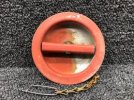
Here a photo of a stock 170 fuel cap. Water collects in the recessed center of the cap and leaks down through the stem.

The 1948 170 I used to own felt like it made water, but it was a feature of the fuel tanks: the right side fuel was actually two tanks piped together so if water got into the system it would get trapped. Same thing can happen with bladder tanks if there are wrinkles in the bladder.
images.jpeg
 
I can see humidity condensing in the tanks, but I don't get the concept of water leaking into the fuel system. If water leaks in, fuel would leak out. More likely the water comes from the supply.
:) but you routinely fly airplanes upside down. If a Cherokee is upside down, something has gone terribly wrong.

From my memory, more or less the top of the fuel cap, less the handle portion, is roughly flush with the top of the wing on that aircraft. The inlet is below that. There's a gasket in the cap that is supposed to seal against the filler. But because of the flush top design, there's kind of a well that can collect water, because the edge of the top of the gas cap does not seal against the side of the opening it fits into. So if it rains enough, the well can fill up with water and that can go into the tank. But, the inlet is a tiny bit above the bottom of the well, so it takes a bit of water to accumulate to get over into the inlet. This needs a picture but I couldn't find one easily on the Internet.

Or in other words, a PA-28 fuel inlet is sort of a funnel with a single gasket to keep water out of the tank if it rains. Single point of failure, and water and gravity always want to win.
 
I can see humidity condensing in the tanks, but I don't get the concept of water leaking into the fuel system. If water leaks in, fuel would leak out. More likely the water comes from the supply.
The old style Cessna caps were notorious for letting water in the tanks, the new ones are much better.
 
I once drained about 20 gallons or so of water out of a plane. It had not flown for about 6 months and had a combination of outside and hangar time. We drained all the sumps till gas came out. Went flying and on the pull up after a flyby over an airstrip about 30 minutes away the #3 engine barked and sputtered for about 2 minutes till it cleared up. Upon arriving back to home field, we drained n other 5 gallons or so of water out of the #3 main tank.
 
EVERY time before I go flying. In 60 years of flying I've only found water twice. Once was about 50 years ago, the other was a few weeks ago.
 
I can see humidity condensing in the tanks, but I don't get the concept of water leaking into the fuel system. If water leaks in, fuel would leak out. More likely the water comes from the supply.
Rain can get in through a leaky cap gasket, or the vent, or (in the case of many older planes) around the wire for the cork-and-wire fuel gauge.
 
Rain can get in through a leaky cap gasket, or the vent, or (in the case of many older planes) around the wire for the cork-and-wire fuel gauge.

Yeah, I guess other caps are more vulnerable. Mine are the type with an overlapping flange, so you would basically have to be submerged.

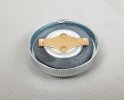
20181130_152917_1__13469.jpg
 
Some tanks don't really encourage the water to migrate to the sump. One has to get the nose up a little. The 150/152s are bad that way.

Taildraggers rule...
 
The old style Cessna caps were notorious for letting water in the tanks, the new ones are much better.
The new ones still do it. There's a silicone rubber check valve in it that is supposed to prevent fuel being sucked overboard. It gets a little old and weak and loses its tension against its seat, and it will let rainwater in. Heavy rain will splash against the cap's vent holes and get in there. Snow will cover that cap, and as it melts it will form a dam that piles the water up around the cap.
 
Always before every flight, and after every re-fueling. Why wouldn't you? It only takes ONE time you didn't look for water or detritus in your fuel to result in a takeoff engine stoppage. Having said that, I have NEVER found water in my tanks, and rarely any flecks of detritus, but I have the knowledge that I significantly reduced the probability of a takeoff engine stoppage by simply checking.
 
Since we mentioned debris, how many of you check your fuel inlet screen at least annually?

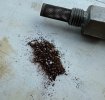
My buddy found this in a PA28 with a series of pencil whipped annuals.

IMG_8585.jpg
 
I started finding water a lot more often when I started catching the gascolator sample in a jar instead of pouring it on the ground.
 
Before flying and after fueling. Occasional I would rent a 150 found water in the right tank on a regular basis. The belly drain didn’t produce water.
 
Since we mentioned debris, how many of you check your fuel inlet screen at least annually?

My buddy found this in a PA28 with a series of pencil whipped annuals.

View attachment 150270
That's the inlet screen in the carb, and most of them never get removed. I have also found gascolator bowls seized on the body, indicating that successive mechanics haven't had that bowl off for a very long time, to check the gascolator screen.

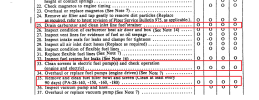
From the PA-28 Service Manual:

1772591843386.png
1772591809477.png

Look at that. Every 50 hours they recommend cleaning of the fuel pump filter, the carb inlet filter, and the gascolator (fuel filter) bowl and screen. Cessna recommends that every 100 hours.

I can just hear the cries: "What?? the fuel pump and carb have screens??"
 
A few times in rentals, but in the 650+ hours I've flown my plane, I've never seen water, even after parking outside in rain when traveling.
 
Left tank, never.
RIght tank, often, but not much.
I have Shaw 501 fuel caps and just recently figured out how to replace the o-ring on the locking mechanism. Parts to rebuild both caps are in the cart for my next big order. (Plane is down for a new engine.)
 
Since we mentioned debris, how many of you check your fuel inlet screen at least annually?

My buddy found this in a PA28 with a series of pencil whipped annuals.

View attachment 150270
Every year at annual inspection I check mine. The first time 9 years ago I found a small amount, none since then.
a24706bf-c411-4e71-ac83-43b1a3549d66.heic

How many change this gasket in the gasolator each year as recommended by Cessna?
27fd45c6-4034-4427-abbf-89601dc73600.jpg
 
Back
Top