John Baker
Final Approach
- Joined
- Oct 4, 2008
- Messages
- 7,471
- Location
- San Diego, California
- Display Name
- John Baker
- Home Airfield
- KMYF
I was going to put this with the e-mails, but I think it needs its own thread.
John
----- Forwarded Message -----
Sent: Wednesday, September 28, 2011 8:52 AM
Subject: Galloping Ghost Crash---The Latest Theory!!!
Galloping Ghost Crash---The Latest Theory!!!
Some GOOD photos here.
>
> Telemetry downloaded from Galloping Ghost revealed an 11g pullup, fuel flow
> interrupted on the way up, and then the engine restarted when fuel flow
> resumed at the top of the arc. The aircraft was making 105 inches of MP
> (Manifold Pressure) on
> the way down.
>
> >Colleen Keller
> Sport Class Race 8 Crew
>
> Subject: : Galloping Ghost crash
>
> Ok... here's the skinny on the accident.... A P-51 normally has two trim
> tabs.. one on each elevator... this one had one and other one was fixed in
> place.. He was warned about the forces being put on that one tab. It
> failed.. He had at least a 10G load when the plane pitched up from the loss
> of the trim tab and he went "nighty night" and probably never woke up.
>
> Here's the "theory" of the crash from experienced racers.
>
> In 1989 this type of thing happened to another pilot but he lived to tell
> the story. When flying a P-51 at 450+mph you need to have full nose down
> trim to keep the plane level. The elevator trim tab broke off and the
> aircraft immediately went in to a 10G climb, confirmed by the G-meter. The
> pilot came to, from the sudden blackout and realized he had slipped through
> the shoulder harness and was looking at the floor of the airplane. He was
> able to reach the throttle and pull it back to slow down and was able to
> recover and land.
>
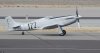
> Photo one s the airplane taxiing, note the pilots head in the canopy.
>
> Fast forward to 2011
>
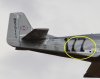
> Photo two is typical oil canning as a result of the tremendous torque these
> engines put out at high power.
>
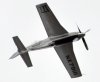
> Photo three is a photo of GG upside down with a missing elevator trim tab.
> Note all you see is the back of the pilots head indicating he is being
> forced down in the cockpit.
>
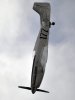
> Photo four is a view of the left side nose down with the tail wheel extended
> and no view of the pilot. The tail wheel is held up by hydraulics only with
> no mechanical uplock, thus indicating a high G-force causing it to extend.
>
> Photos five and six are from the left side prior to impact, note no view of
> the pilot and the tail wheel extended.
>
> Photo seven is the debris just after the crash. To the right of center above
> the crowd it appears to be the wing with the leading edge down.
>
> A friend of mine was supposed to be there but didn't go and he has several
> friends in the hospital right now. The people were mostly hit by chunks of
> concrete, asphalt and aircraft debris. They were also hurt by the trampling
> of people getting out of the way.