Engine problem - tech support needed pls!

lockeed

Pre-takeoff checklist
Joined
Jan 18, 2012
Messages
151
Location
Gaspe - Quebec
Display Name
John
Home Airfield
CYGP
Hey Guys. Here's the story - bear with me !!

Technical info: O-360 A1A 180HP // +/- 80hrs since full overhaul at Lycoming - Yellow tag engine.

Hangar and Ext. Temp -9 deg C (15 deg F)

Went to the hangar today, took off the cowlings and changed the oil + filter for the winter (Exon Elite 20W-50). While I was doing misc maintenance on the plane, I pluged the pre-heater pad + my heater for an hour, everything covered under my engine cover laying over the engine bay.

Then I started the engine which started on the first 1/4 turn - All good.
biggrin.gif


I left the engine idling for a couple minutes, gradualy leaning... Then 1000rpm fully leaned idle for at least 5 minutes till I started to see the oil temp needle rising. Then I gradualy put full mixture and raised the engine to 1700rpm and did a quick mag check - all good. I left the engine run at 1700rpm for a couple minutes, during which it got up to +/- 75deg. F. on the oil temp gauge. (note that both cowlings were not on the engine while I did the test run so, the engine is much harder to warm up)

Once I had +/- 75 deg. F, I increased the RPMs to 2000, to get the engine somewhat up to normal temperature. Left the engine run at 2000rpm for 2-3 minutes, then back down to 1000RPM lean idle and left it there for a minute. Highest temperature I got on the gauge was aprox 90 deg. F. (again, no cowlings...) All other parameter in Green.

Here's the interesting part. I gradualy put full rich, then increased the throttle to get 2000RPM again and the engine hesitated and burped, as if it was missfiring. As I increased the throttle slighly, the engine dropped in RPM as if a "choke" was on and it backfired - then I pulled the throttle to idle and leaved it alone for a second while I gradualy leaned it.

Engine still turned fine on idle. After 30 seconds, full mixture and I increased the throtle to get to 1700RPM to do another mag check, it hesitated a bit but eventualy got up to 1700RPM and stayed there while I checked both mags to make sure. All Good. Once done, I increased the throttle to obtain 2000RPM, again - same thing, hesitation then drop in RPM. I cut the thottle before a backfire could occur this time...

I stopped the engine, did a visual check and inspected for leaks, checked the oil. All good.

Got back in, did pretty much the exact same thing. It hesitated a little bit between 1000 and 1500RPM, but I increased the throttle verry gradualy, and I ran it full power and it didn't hesitated this time at higher RPM...

I brought the RPM to 1000RPM, full lean for a minute then pull the mixture off. Than I ran to my computer to write this message!!
biggrin.gif
Joking of course, I had dinner before running to my PC actualy....
tongue.gif


Now, what do you guys think might cause this?

While doing test run, I often switched tanks, to try to eliminate variables one by one. I ran with the boost pump on, didn't changed anything. There was no water in the tanks. The tank vents under the fuselage seamed to be free of any debris and I ran a cable into them whitout any obstacles.

One other thing. The very last flight I did was back in mid September. After about an hour of flight, I lined up on the runway in a nearby town for the last leg back home, gave it full throttle, then the engine hesitated and did the exact same symptoms it just did today. It wouldn't take full power. BUT, I had just washed the plane a couple minutes ago and I thought at this point that water must've had acumulated in the carburator housing/bowl or in the air filter, and got sucked in on full power. That day, I cleared the runway and got back to the parking area to check anything I could. After 10-15 minutes laying there with the engine stopped, I tought to myself that the heat coming from the engine would make any remaining water evaporate and dry... After I restarted the engine, it ran fine and got back home safely and without any hesitation from the engine.

A couple things I suspect.

-carburator problem
-missfirering / spark plugs
-fuel filter / fuel system

Let's hear what you guys think!
 
Just to be clear, this engine has sat for the last four months, before you changed the oil today?
 
Yes it did - kind of... I went to the hangar about 2 weeks ago and ran it for 15 minutes to bring the temps up - it ran good. I was reassured then... but today, same thing as the last flight in Sept...
 
Sumps? Please clarify. English is a second language for me and sometimes, those terms don't mean the same thing when we use it in a french conversation...

I did drain the tanks with the drain plug under both wings, is that what you're reffering to?
 
You opened the throttle with out enriching the mixture ? Of course it won't run right.
 
You opened the throttle with out enriching the mixture ? Of course it won't run right.

Nope, didn't do that. Always full rich everytime I go over 1k RPM.

Did you read that in the text Tom?
 
Nope, didn't do that. Always full rich everytime I go over 1k RPM.

Did you read that in the text Tom?

What is the outside air temps in F?

carb ice on the ground will collect quickly and cause what you describe.
 
Ext. Temp -9 deg C (15 deg F)

But the engine did the same thing on takeoff in Sept on a 70 deg F sunny day
 
Ext. Temp -9 deg C (15 deg F)

But the engine did the same thing on takeoff in Sept on a 70 deg F sunny day

In your cold weather -15F, you may have your accelerator pump set too lean. it is not providing enough fuel to transition from the idle circuit to the cruise jet. during the transition the fuel air ratio will go lean and cause the engine to stumble, and cough.

that is in the zone of 1000-1200RPM.
 
That is possible - but why would it stumble going from magneto check RPM (1700RPM) to 2000RPM ?

By the way, our temperature today was 15 deg. F, not minus 15.
 
Sumps? Please clarify. English is a second language for me and sometimes, those terms don't mean the same thing when we use it in a french conversation...

I did drain the tanks with the drain plug under both wings, is that what you're reffering to?

Sump = puisard
 
OK, we're talking about the gascolator.... Always like to make sure on technical stuff.

2vij9mo.jpg


No, I did not drain it, as I've never played with one before... Shouldn't be too hard to do though?
 
Last edited:
I've asked some questions on Van's forum and a mecanic suggested that I don't have the right carb for my plane. I have a O-360 A1A // 180HP with the Marvel-Schebler 10-3878, and here's the answer he gave me.

You've got the wrong carb. 10-4164-1 is the one you want and will have the main jet sized properly to avoid the stumble. You can change the jet to match the 41641, thus the part number will change. The carb part number used is airframe-specific. 10-41641 works the best for the RV with the O-360.

The only difference is the size of the main jet and the economizer jet setting. I can't remember if the discharge nozzle is different.

You will get rid of the stumble setting the carb up for the 10-4164 specs.

10-3878 is the most efficient and basic carb, the 10-4164 runs a little richer. There is also a 10-3878M part number that is slightly richer, not sure if that solves the stumble problem.

There is a kit available to convert your carb to proper spec for your plane, part # is A666-660 .


What do you guys think? were some of you guys aware of this mod and it's effet on O-360's ?
 
In your cold weather -15F, you may have your accelerator pump set too lean. it is not providing enough fuel to transition from the idle circuit to the cruise jet. during the transition the fuel air ratio will go lean and cause the engine to stumble, and cough.

that is in the zone of 1000-1200RPM.

Tom, I guess there's a procedure to set the accelerator pump to be a bit richer ?
 
Yes it did - kind of... I went to the hangar about 2 weeks ago and ran it for 15 minutes to bring the temps up - it ran good. I was reassured then... but today, same thing as the last flight in Sept...
Went to a seminar on engine management a couple of weeks ago. The mechanic said that 15 minutes isn't enough time to bring the oil temp up high enough to burn off all the contaminants. You need to really get it up and fly it for about an hour. The shorter period and lower time just causes condensation, which can actually be detrimental to the engine.

That's not related to your complaint, however.
 
Tom, I guess there's a procedure to set the accelerator pump to be a bit richer ?

yes,, there are three holes that regulate the travel of the piston, short strokes get you less fuel, the middle and the longer strokes get you more fuel.
 
I've asked some questions on Van's forum and a mecanic suggested that I don't have the right carb for my plane. I have a O-360 A1A // 180HP with the Marvel-Schebler 10-3878, and here's the answer he gave me.

You've got the wrong carb. 10-4164-1 is the one you want and will have the main jet sized properly to avoid the stumble. You can change the jet to match the 41641, thus the part number will change. The carb part number used is airframe-specific. 10-41641 works the best for the RV with the O-360.

The only difference is the size of the main jet and the economizer jet setting. I can't remember if the discharge nozzle is different.

You will get rid of the stumble setting the carb up for the 10-4164 specs.

10-3878 is the most efficient and basic carb, the 10-4164 runs a little richer. There is also a 10-3878M part number that is slightly richer, not sure if that solves the stumble problem.

There is a kit available to convert your carb to proper spec for your plane, part # is A666-660 .


What do you guys think? were some of you guys aware of this mod and it's effet on O-360's ?

When you re-jet any carb it will run richer all the time, when you adjust the accelerator pump to cure the stumbling during transition, it will only run richer during that period.

To me that is a better fix.
 
Do you need to open the carb to access the accelerator pump? I,d like to see in which position it is right now...?

I know on most muscle car I've worked on, the accelerator pump is right there on the side, but on a Marvel Schebler... :confused::confused:
 
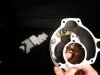
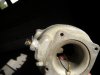
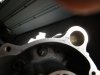
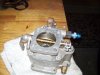
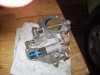
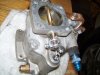
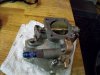
Let's see if I can find some pictures;

you will see a rod sticking up thru the carb top plate, it will be connected to the throttle shaft by a lever and link that will raise and lower the pump into the carb float bowl, there will be three holes on the lever that the link will fit into. see which one it is in. the top hole will be the richest, the bottom is the leanest. and remember the engine will stumble when it is too rich also.

Pull the two cotter pins that hold the link in its position,
remove the link, work the rod up and down, there should be a fuel produced at each stroke, and soon fuel will be seen dripping out of the bottom of the carb when the pump is working correctly.

If you get no fuel, but the piston works hard you may have a clogged nozzle.
 

Attachments

  • DSCN1797.jpg
    DSCN1797.jpg
    212.1 KB · Views: 11
  • DSCN1798.jpg
    DSCN1798.jpg
    205.3 KB · Views: 9
  • DSCN1796.jpg
    DSCN1796.jpg
    202.9 KB · Views: 11
  • HPIM0660.jpg
    HPIM0660.jpg
    205.6 KB · Views: 12
  • HPIM0680.jpg
    HPIM0680.jpg
    207.9 KB · Views: 10
  • HPIM0681.jpg
    HPIM0681.jpg
    207.1 KB · Views: 10
  • HPIM0684.jpg
    HPIM0684.jpg
    202 KB · Views: 9
  • HPIM0682.jpg
    HPIM0682.jpg
    179.3 KB · Views: 8
Last edited:
Thx for the pics and instructions Tom. I'll be at the hangar this afternoon and I'll look it up.
 
Let's see if I can find some pictures;

you will see a rod sticking up thru the carb top plate, it will be connected to the throttle shaft by a lever and link that will raise and lower the pump into the carb float bowl, there will be three holes on the lever that the link will fit into. see which one it is in. the top hole will be the richest, the bottom is the leanest. and remember the engine will stumble when it is too rich also.

Pull the two cotter pins that hold the link in its position,
remove the link, work the rod up and down, there should be a fuel produced at each stroke, and soon fuel will be seen dripping out of the bottom of the carb when the pump is working correctly.

If you get no fuel, but the piston works hard you may have a clogged nozzle.
Tom, is there an easy way to test how well the pump is functioning while on the engine? I'm thinking you might be able to block the nozzle with a finger (probably not) and feel the resistance of the pump when operating it by hand or with the throttle. Alternatively if you can see the fuel streaming out of the nozzle, there might be a visual image of a good vs not so good pump's output when operating the throttle full stroke at a specific rate.

Of course, all this is moot for me in that AFaIK the carb on the A65 in my taildragger has no accelerator pump and the only way I can keep it from stumbling (especially when it's cold) is to advance the throttle very slowly.
 
That is possible - but why would it stumble going from magneto check RPM (1700RPM) to 2000RPM ?

By the way, our temperature today was 15 deg. F, not minus 15.

Carburetor ice can form at temperatures up to 100°F. There's a common misconception that it's a winter phenomenon when in fact it can be worse in warmer weather simply because warm air can hold more moisture.

A carburetor is a small refrigerator. As air passes through the venturi its pressure, and therefore temperature, drops. As fuel sprays into the airstream it vaporizes, absorbing heat from the air. between the two factors we can get as much as a 70°F drop, enough to cause condensation and freezing of airborne water vapor.

carbice.jpg


Some engines do not run right without the cowling. The pulsating propeller airflow against the intake upsets mixture distribution and homogeneity and causes roughness, though hesitation would be rarer. The cowling directs air PAST the intake, not against it, and reduces the pulsation. The older 182s were famous this way, and the occasional 172, among others.


Weak spark will also cause serious hesitation. Maybe both mags need a going over.

Dan
 
Last edited:
Tom, is there an easy way to test how well the pump is functioning while on the engine?

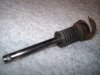
look at the pictures I put up, in one you will se the small copper tube extending from the side of the air passage up into the venturi area, that tube is the nozzle, and it is about 2" long. combine that with having any induction system on the carb would make placing your finger on the end pretty difficult.

You can get to the pump with out removal from the engine. by removing the link between the pump and the throttle shaft, you can work the pump and it's pretty easy to tell if the pump is pumping.

If it isn't working simply remove the carb and send it to me, I "" repair "" these for $150, plus parts and shipping.

never ever have a MA3 overhauled, Kelly ruins it.
 
Hey guys. I was finaly able to go to the hangar today.

I spent the entire afternoon there and came back home at 7pm, with an empty stomach, but with a great deal of knowledge aquired.
smile.gif


I went there with intention of geting rid of the problem... so, a lot of things have been checked meticulously.

-Gascolator (drained)
-Fuel lines
-carb + hardware
-fuel tank cap seals
-Intake hoses + clamps
-primer line
-Carburator rod + butterfly
-Air filter
-air box + support plate / cleaning
-etc.....

Here are the reason why my engine had stumble and hesitation:

#1 - Fuel contamination.
#2 - Debris in carburator

Check picture of the water drainded from the gascolator and the debris picked up in the carb sump during drain.

Put everything back togueter, re-installed both cowlings (alone!
eek.gif
) and did a test run. (temp -4 deg c / dew point -7 deg c / hum. 77%).

Oil temperature came up quickly - as expected with both cowlings in place. Idle, 1700RPM mag check and 2000RPM test went great. Engine now perform as expected.

I'll make an drain extention for my gascolator that I'll poke under the lower cowling - so I can drain it before each flight. If you guys have pictures of a similar setup - I'd like to get inspired!

I didn't had enough time but next time I take off the lower cowling, I'll clean up the screen at the entrance of the carburator - I've been told it would be a good idea to do it once a year... If you guys have instruction on how to do it, I'd like to hear you. I guess with the carburator manual, I should be OK too... we'll see...

There you go, one problem solved, for now!
biggrin.gif


giu2n.jpg

qumb1.jpg
 
OK, we're talking about the gascolator.... Always like to make sure on technical stuff.
2vij9mo.jpg


No, I did not drain it, as I've never played with one before... Shouldn't be too hard to do though?

Glad you found the problem.:yesnod::yesnod::yesnod:

Hard to believe you have never drained the gascolator before each flight..:hairraise::yikes::yikes::eek:.

Ben.
 
Did you pull the carb drain plug to see what was in there too.?
 
Yes Tom, the second picture on my previous post show the debris I picked up in the carb sump from the drain.
 
Back
Top