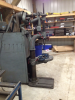
Electric motor wiring question.

poadeleted21

Touchdown! Greaser!
Joined
Aug 18, 2011
Messages
12,332
I have a 1hp 110/220v Rockwell electric motor on my drill press. It currently has the standard 220v dryer plug on it. I put a 30amp breaker in the box, white and black wires into the breaker, ground to the ground strip. Runs great in "forward", but when I flipped it to reverse, it just hummed. Motor has 2 light switches wired into it. On/off and forward/reverse. I believe reverse was working with the way the drill is currently wired to the switches. Did I mess up wiring in the breaker/receptacle?
 
I have a 1hp 110/220v Rockwell electric motor on my drill press. It currently has the standard 220v dryer plug on it. I put a 30amp breaker in the box, white and black wires into the breaker, ground to the ground strip. Runs great in "forward", but when I flipped it to reverse, it just hummed. Motor has 2 light switches wired into it. On/off and forward/reverse. I believe reverse was working with the way the drill is currently wired to the switches. Did I mess up wiring in the breaker/receptacle?

Well... the typical setup is that a DPDT switch controls the polarity of the capacitor with respect to the motor. Will the motor run in reverse if you manually nudge it in that direction while it's humming?

-Rich
 
Well... the typical setup is that a DPDT switch controls the polarity of the capacitor with respect to the motor. Will the motor run in reverse if you manually nudge it in that direction while it's humming?

-Rich

It might, the humming didn't sound good so I shut it off. Drill has been sitting in a shop in MS for about a year and half.
 
Was it set up to reverse before?
Can you identify the start vs the run wire?
Any info on the back of the wiring box cover?
 
Was it set up to reverse before?
Can you identify the start vs the run wire?
Any info on the back of the wiring box cover?

It was setup to run in reverse before. I touched none of the wiring on the drill. Just plugged in a breaker and ran the wire.

I'll look this afternnon when I get home.
 
If it runs OK in fwd, I'd guess an issue with the switch, maybe? If it had problems in both directions, I'd suspect the motor, start cap, or start relay.
 
I have a 1hp 110/220v Rockwell electric motor on my drill press. It currently has the standard 220v dryer plug on it. I put a 30amp breaker in the box, white and black wires into the breaker, ground to the ground strip. Runs great in "forward", but when I flipped it to reverse, it just hummed. Motor has 2 light switches wired into it. On/off and forward/reverse. I believe reverse was working with the way the drill is currently wired to the switches. Did I mess up wiring in the breaker/receptacle?

dryer2.jpg

With an A/C volt meter check the receptacle you plug the drill into. 110V from one flat prong to the "L" shaped one, and 110V from the other flat prong to the "L" shaped one. 220V between the two flat prongs.

The image shows a red wire. You used the white in place of red and the bare copper in place of white. I assume you have no ground wire. The ground and neutral (white in the image) wire can be connected.
 
I don't have an L. Black and white went to the breaker. Bare went to the ground block.

Here's what I have.

Leviton-061-5374-rw-163438-228149.jpg
 
Given what you've written, it's got to be something in the drill press.

Each wire in the panel/breaker/plug is ~120V to ground and 180 degrees out of phase with the other "hot" wire. reversing them would make no difference.

If it was 3 phase (3 hots) it's different and reversing the motor is a matter of swapping any 2 of the hots. But this is single phase. (Why they call it single phase when there are 2 phases I've never understood.) :dunno:

John
 
Ok, stupid question. Sorry if it is so basic. Does the machine have a switch that switches from 220 to 110?

I don't know enough about electricity to know if it would run on 110 when switched to run on 220.

Just throwing out an idea.
 
Ok, stupid question. Sorry if it is so basic. Does the machine have a switch that switches from 220 to 110?

I don't know enough about electricity to know if it would run on 110 when switched to run on 220.

Just throwing out an idea.

Typically when a motor is listed as being able to work with more than one voltage, the change is made when wiring inside the small wiring box located on the motor. You use certain wires and tie others togther for a given voltage. This is usually spelled out on a sticker in the box or on the motor. Here is an example for a typical 3 phase motor that can run on 230 or 460V:
24710d1280159856-230-460-wiring-15hp-idler-motorwiring1.jpg
 
Given what you've written, it's got to be something in the drill press.

Each wire in the panel/breaker/plug is ~120V to ground and 180 degrees out of phase with the other "hot" wire. reversing them would make no difference.

If it was 3 phase (3 hots) it's different and reversing the motor is a matter of swapping any 2 of the hots. But this is single phase. (Why they call it single phase when there are 2 phases I've never understood.) :dunno:

John

The moto is "retro-fitted" onto the drill (it was originally a drive line based system). The wiring is an electrical box with 2 light switches mounted to it. The motor has been sitting unused in a humid shop for 20 months. Probably needs a good cleaning and some new switches... that'll be my 1st line of defense.

Thanks.
 
Ok, stupid question. Sorry if it is so basic. Does the machine have a switch that switches from 220 to 110?

I don't know enough about electricity to know if it would run on 110 when switched to run on 220.

Just throwing out an idea.

It would, it would just be underpowered. Dual voltage motors have two sets of winding (actually three including start windings if so equipped). The windings are wired in parallel for for 110V operation, and in series for 220V operation, which halves the current draw and keeps the power output the same. These are the wiring changes configurable in the motors starter box.

The converse, running a motor set up for 110V on 220V would be a bad thing.
 
Well... the typical setup is that a DPDT switch controls the polarity of the capacitor with respect to the motor. Will the motor run in reverse if you manually nudge it in that direction while it's humming?

-Rich

You win this thread. Gave it a tug after it started humming in reverse and that did the trick. The switch started smoking, I turned it off, gave everything a good clean inning, replaced the switches and wah-la ... good as new.

Drill is approx 85 years old and back in business.
 
You win this thread. Gave it a tug after it started humming in reverse and that did the trick. The switch started smoking, I turned it off, gave everything a good clean inning, replaced the switches and wah-la ... good as new.

Drill is approx 85 years old and back in business.

Good. I like keeping old things in service.

The reason I asked you to hand-prop it was, as you found out, because when they work that way, the problem almost always is the switch or the starter cap. If not, then usually it's the wiring or the motor itself. At least that's been my experience.

-Rich
 
You win this thread. Gave it a tug after it started humming in reverse and that did the trick. The switch started smoking, I turned it off, gave everything a good clean inning, replaced the switches and wah-la ... good as new.

Best way to troubleshoot electronics. Keep screwing with it until you smoke something. Then replaced smoked part:D

Glad to here you have it working again.
 
Given what you've written, it's got to be something in the drill press.

Each wire in the panel/breaker/plug is ~120V to ground and 180 degrees out of phase with the other "hot" wire. reversing them would make no difference.

If it was 3 phase (3 hots) it's different and reversing the motor is a matter of swapping any 2 of the hots. But this is single phase. (Why they call it single phase when there are 2 phases I've never understood.) :dunno:

John

It's because the reference is to the primary side of the utility transformer, not the secondary. The primary is connected to only one of the 3-phase distribution lines and neutral (ground).

The secondary is center tapped (split phase) to provide 120/240(rms), and although the two hots are 180* out of phase at any point in the cycle, they both start at zero and reach peak voltage (~170 volts), at the exact same moment in time. Basically a mirror image, opposite polarity.

There is no lead/lag in time, as in 3-phase (or 2-phase/90*).
 
Last edited:
Good. I like keeping old things in service.

The reason I asked you to hand-prop it was, as you found out, because when they work that way, the problem almost always is the switch or the starter cap. If not, then usually it's the wiring or the motor itself. At least that's been my experience.

-Rich

Well, here she is. It's up and running. I can't leave well enough alone so I'll be doing some tinkering and restoring it over time.

It's a Canedy-Otto camelback. I believe it was built around 1930. My dad had nicer drill's but this one was the only single phase one, and it's the one he had the longest. Built like a brick ----house and VERY easy to use. I'm sure it will be running 85 years from now. They don't build em' like they used to.

attachment.php
 

Attachments

  • drill.png
    drill.png
    658.2 KB · Views: 94
It's because the reference is to the primary side of the utility transformer, not the secondary. The primary is connected to only one of the 3-phase distribution lines and neutral (ground).

The secondary is center tapped (split phase) to provide 120/240(rms), and although the two hots are 180* out of phase at any point in the cycle, they both start at zero and reach peak voltage (~170 volts), at the exact same moment in time. Basically a mirror image, opposite polarity.

There is no lead/lag in time, as in 3-phase (or 2-phase/90*).

Ah! That makes sense. I never thought about the primary side. I knew the configuration of the secondary with the center tap.

Thanks. That's puzzled me for years.

John
 
Well, here she is. It's up and running. I can't leave well enough alone so I'll be doing some tinkering and restoring it over time.

It's a Canedy-Otto camelback. I believe it was built around 1930. My dad had nicer drill's but this one was the only single phase one, and it's the one he had the longest. Built like a brick ----house and VERY easy to use. I'm sure it will be running 85 years from now. They don't build em' like they used to.

attachment.php

Wow! That's cool! And it's a OSHA nightmare. I'm glad you're keeping it.

I rebuilt the power supply on a 1956 "One Girl Automatic Taper" machine. (That's the actual name of the machine on the cover of the manual that came with it!) It was used to tape the corner of a cardboard box and cut the tape off. Had a solenoid fired blade with a coil about 4" in diameter and 8" long. Cut off 4" wide gummed paper tape. It had a selenium rectifier which had blown. I replaced it with a solid state bridge rectifier. Worked like a champ for about a week. Then the solid state bridge blew. I learned that the solid state rectifier, unlike the selenium one it replaced had to be protected from the reverse EMS spike when the knife retracted into the coil.

Interesting quirks in some of these old machines. But very cool as far as I'm concerned.

John
 
This is the switch you should have on that thing.

51927-ProductImageURL.jpg


The two light switches present the danger of switching both on at the same time and creating a short.

Dan
 
Wow! That's cool! And it's a OSHA nightmare. I'm glad you're keeping it.

I rebuilt the power supply on a 1956 "One Girl Automatic Taper" machine. (That's the actual name of the machine on the cover of the manual that came with it!) It was used to tape the corner of a cardboard box and cut the tape off. Had a solenoid fired blade with a coil about 4" in diameter and 8" long. Cut off 4" wide gummed paper tape. It had a selenium rectifier which had blown. I replaced it with a solid state bridge rectifier. Worked like a champ for about a week. Then the solid state bridge blew. I learned that the solid state rectifier, unlike the selenium one it replaced had to be protected from the reverse EMS spike when the knife retracted into the coil.

Interesting quirks in some of these old machines. But very cool as far as I'm concerned.

John

My dad built the big metal box around all the pulleys and gears "for safety". He ran that drill for 35 years, I don't recall anyone ever getting hurt with it.
 
A thing of beauty!

If you end up with any 3phase stuff, let me know. I have some three phase stuff in my shop and use a drive to make 3phase. I can help you with that.

Did you ever make the basketball game/machine?
 
A thing of beauty!

If you end up with any 3phase stuff, let me know. I have some three phase stuff in my shop and use a drive to make 3phase. I can help you with that.

Did you ever make the basketball game/machine?

Just getting everything together and the shop pieced together. Going to be my first project. I have to go get the lathe this weekend. I have a 3 phase vertical mill. I've heard the 3 phase convertors don't work too well so I was gonig to sell it.
 
You just need to purchase a VFD. One size larger than your motor. You can feed it with single phase and the VFD will make three phase to run your motor
 
If you have a 110v lamp running off two hots and a ground only (no dedicated neutral) I believe you are 'using the ground as a neutral' which might be an unsafe condition?
Love your old machine, it'll probably last another 100 years.
 
Just getting everything together and the shop pieced together. Going to be my first project. I have to go get the lathe this weekend. I have a 3 phase vertical mill. I've heard the 3 phase convertors don't work too well so I was gonig to sell it.

What HP is the mill? Get me the FLA on the motor and I'll see what I can find for a drive in old stock.
 
This is the switch you should have on that thing.

51927-ProductImageURL.jpg


The two light switches present the danger of switching both on at the same time and creating a short.

Problem it that is designed for 3 phase and swap a phase to reverse it.
 
You just need to purchase a VFD. One size larger than your motor. You can feed it with single phase and the VFD will make three phase to run your motor

Plus then you can vary the speed also with out belt changes.
 
I'm not sure where you guys buy your VFDs from, but the ones I get cost more than a quality drill press.
 
I'm not sure where you guys buy your VFDs from, but the ones I get cost more than a quality drill press.

The price point on VFDs has really dropped. $100 per hp is not unheard of now.
 
The little I know about VFDs says the the motor needs to be sized for such use because changing the speed of a fixed speed motor changes the current, which can overheat the motor and burn it up. I'm open to being corrected, but all the variable speed motors I've worked on were either DC (easy to change speed-change voltage) or built with special windings.

John

Typically inverter duty motors have heavier windings and potting to withstand pulsing and harmonics caused by the VFD, at least in large three phase motors. However, newer VFD technology generally minimize it sufficiently that it isn't an issue anymore in most cases.
 
Problem it that is designed for 3 phase and swap a phase to reverse it.

Nope. That's a single-phase reversing switch. It feeds both the run and start windings. It reverses the polarity of the start winding when you select reverse.

I have used them at least twice on single-phase motors.

single%20phase%20drum%20switch.jpg


Dan
 
Last edited:
The little I know about VFDs says the the motor needs to be sized for such use because changing the speed of a fixed speed motor changes the current, which can overheat the motor and burn it up. I'm open to being corrected

VFD are smarter then that. Yes you will use more current at slower speeds (lower frequency). But the VFD will limit the current and shut down if the motor is drawing to much current.
This is of curse assuming you have the right size VFD and it is set up right. I have seen some really weird setups with VFD that could possible burn up the motor.
 
Nope. That's a single-phase reversing switch. It feeds both the run and start windings. It reverses the polarity of the start winding when you select reverse.

I have used them at least twice on single-phase motors.

Dan

Ok I stand corrected. All the ones I have used that looked like that were for 3 phase and swapped a phase.
 
Generally speaking, the risk of insulation damage from dV/dT spikes on non vfd rated motors is not a concern at 230v. Also, using a vfd as a "phase converting soft starter" on home shop/garage equipment is pretty safe for the motor.

One should not, however, expect to run that motor below half speed for any length of time or overheating is a risk. Motors that need/are built for airflow through/over the motor during operation don't cool themselves very well at slower speeds.
 
Back
Top