Effective club management models.

billsgs126

Line Up and Wait
Joined
Apr 10, 2025
Messages
702
Location
KASE
Display Name
William
Home Airfield
KHXF
I have belonged to a not-for-profit club for several years. Although I admit to having no other experience in this regard, it seems to be well managed and has been a great resource in keeping my flying costs down as I gained skills and accumulated hours. This post is not about that club.

I am aware of a second club that is not doing nearly so well. Decisions were made to embark on changes, which cost the club membership as well as restructuring costs (a double whammy of less money coming in and more going out) shortly before an unexpected (but foreseeable) issue that could not be deferred derailed everything. (Meaning that even more money would be going out. If that money were available. But it isn't.)

People are imperfect, so anything they create will be imperfect. Businesses and clubs fail every day because of the unforeseen, that's why you hedge and diversify. I am just trying to learn from the examples that I am aware of.

For people who are in clubs. Is it typical that (using my improperly calibrated eyeballs) 10% or so of the members fly something like 40% of the hours with another 40% or so of the members flying 10%? Does everyone who is up to date with their dues have a say - or even a vote - at meetings? Is there any sort of "supermajority", requirement for two sequential votes, or limiting language in the club bylaws that would delay changes to the clubs mission or goals?
 
I am aware of a local club that has 10 members. I've given instruction to some of them. Over the years, I formed the opinion that two or three fly regularly, one or two more fly occasionally, and the rest don't fly at all. I think they all get an equal vote on maintenance or improvement decisions.
 
I was on the board of a non-airplane private organization that was setup to make it very difficult for outsiders to take it over. The officers, who were appointed by the board of directors, ran all day to day operations. The board of directors consisted of 9 members who served 3 year terms, staggered so 3 were elected each year. The interesting part was that while there was an election by the general membership each year, and they could vote for 3 candidates, only the top two people were elected by the general membership. The final spot, each year, were elected by a vote of the board of directors.

It was setup this way a long time ago, to avoid a situation where a small club could double in membership by a group of outsiders joining, who would then vote in their new friends and take over a club that may have significant assets. With the model above, in theory it would take years to attempt a forced takeover, and in reality if anyone tried to start it they'd just be bounced out of the club by being 7:2 overridden at the director level.

As far as keeping a club from doing goofy things, though, that's tougher.
 
For people who are in clubs. Is it typical that (using my improperly calibrated eyeballs) 10% or so of the members fly something like 40% of the hours with another 40% or so of the members flying 10%?
I never really looked at it in terms of percentages of hours, just total hours. However, pretty reliably (in a 30-member club) every year we had 10% of the members flying >50 hours each, 40% 10-50, 40% 1-10, and 10% no flying at all. And the 10-50 crowd was skewed more towards 10 than 50.

Does everyone who is up to date with their dues have a say - or even a vote - at meetings?
As we were an equity club and every member owned an equal share, yes.

Is there any sort of "supermajority", requirement for two sequential votes, or limiting language in the club bylaws that would delay changes to the clubs mission or goals?
No.

That said, we had a very well-run club. I was in the club for 14 years and on the board of directors for all but a few months of that. There weren't a whole lot of things that we didn't make better in that time. We turned over the entire fleet - Started with a couple ratty old Archers and a ratty old 182. Painted the 182 right after I joined, and it had an OK panel. Replaced one Archer with a DA40, the other Archer with a somewhat newer and MUCH nicer Archer (thank you @fiveoboy01!) and replaced the 182 with an R182.

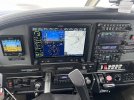
DA40 was G1000, R182 was Aspen when we purchased them. The new Archer was still a six-pack with a 430W and autopilot. But we put the club in the right spot financially that all of the planes got paid off, a couple engines got overhauled, and about a year ago the Archer got a completely new Garmin glass panel (G3X, 650Xi, GFC500, literally everything replaced with Garmin) and the DA40 got a WAAS upgrade to the G1000.

All that on something like $170/mo per member and $1xx per tach hour wet. Screaming deal for a great club with really nice airplanes. I wish everyone had access to a club like that.

cap-city-flyers-fleet.large.jpg

N8113B panel.jpg
 
Last edited:
I sit on the board of a 501(c7) flying club. I’ll do the best to answer your questions as they relate to my experience.

…For people who are in clubs. Is it typical that (using my improperly calibrated eyeballs) 10% or so of the members fly something like 40% of the hours with another 40% or so of the members flying 10%? …
We have about 1/3 that fly above the club average, 1/3 that fly average hours, and 1/3 that fly below average hours. That is, if we divided total hours flown by total club members. We do include a 20 hour flight credit as part of annual assessment. Not everyone flies thru that, and every year at least one doesn’t fly at all for various reasons. Our annual assessment is such that we include the block rate as part of the assessment.

…Does everyone who is up to date with their dues have a say - or even a vote - at meetings?
This is driven by club bylaws and culture. When we were smaller, we ignored the bylaws and instead functioned like a partnership. As we’ve grown and the board has evolved, we are moving a model more aligned with our bylaws and away from consensus decisions.

Of note, our bylaws are clear: 30 days past due revokes your access to the plane and 69 days past due forfeits your membership. We have a process to follow, and have used it effectively in the past.

We are now of a size where the board sets an annual fiscal plan to execute against our bylaws-driven fiscal objectives. Our bylaws allow for simple majority of members present to approve (given a quorum).

…Is there any sort of "supermajority", requirement for two sequential votes, or limiting language in the club bylaws that would delay changes to the clubs mission or goals?
We require a supermajority for a change of bylaws and to liquidate owned aircraft, otherwise it’s simple majority.

Now for some history; our club has been around for 15+ years and nearly went out of business because it was poorly managed from a fiscal sense. The “members” were too cheap as a partner group to make it work if an unplanned expense rose. ADS-B mandate requirements drove a small group to re-write the bylaws as a condition of their private loan to finance ADS-B equipage. That resulted in a non-profit corporate structure replacing the previous partnership structure.

Shockingly, very few of our members actually read the bylaws, despite being provided a copy in the membership packet. We are educating our members on the board’s responsibilities and authority in a nurture/nudge manner and we’re most members would rather be left out of the sausage making so long as they know we’re meeting our annual fiscal obligation to run a balanced budget and fund for upgrades/expansion.
 
For people who are in clubs. Is it typical that (using my improperly calibrated eyeballs) 10% or so of the members fly something like 40% of the hours with another 40% or so of the members flying 10%? Does everyone who is up to date with their dues have a say - or even a vote - at meetings? Is there any sort of "supermajority", requirement for two sequential votes, or limiting language in the club bylaws that would delay changes to the clubs mission or goals?

I’ve been in three clubs and that’s my experience as well. In my current club (15 members) it’s more like two of us flew 80% of the hours last year. My prior club was about the same.

It happens for various reasons. In my current one we have 4 members who have their own planes or shares of other planes (heck, one owns a 1/5 in a SR22 and a vision jet!) so our Archer is third tier. But, good clubs are hard to find. We have 5 members with zero flight time last year but they are places in their lives where they can’t really spend time but they expect to sometime.

A good club is great. I’ve been in one awful one, despite great planes, because it was run by a cabal of old members and they made sure they got preferences. But the two single plane Archer clubs have been awesome. We charge $140 a month and $115 an hour (Hobbs) for a nicely equipped Archer.
 
Last edited:
It is common everywhere that some pilots fly a lot more than others. In a club, it's important to have a structure that links time flow to costs so each member can set their own budget.

Sorry to hear about that other club. Club leaders should always be operating in a fiscally conservative manner and with a healthy dose of paranoia.
 
Now for some history; our club has been around for 15+ years and nearly went out of business because it was poorly managed from a fiscal sense. The “members” were too cheap as a partner group to make it work if an unplanned expense rose. ADS-B mandate requirements drove a small group to re-write the bylaws as a condition of their private loan to finance ADS-B equipage. That resulted in a non-profit corporate structure replacing the previous partnership structure.
I'm an outsider, but from my perspective this seems close to what is happening. Opinions differ, either they didn't have sufficient reserves, perhaps their uses were not sufficiently delineated, or they tapped into them to fund an acquisition, right before a major unexpected expense. A couple members who fly a lot have offered to make a private loan (with conditions), but a larger group who either doesn't fly, or rarely flies isn't interested in giving up control.
 
I was in a 10-person partnership that owned a 172. It wasn’t technically a club, as each of us owned an equal share and it was limited to 10 owners. Each one paid a fixed monthly amount for hangar and insurance, and was billed for 10% of maintenance and inspection costs, regardless of how much they flew. We each paid a dry rate, plus actual fuel cost if we used the group’s credit card.

In the 8-1/2 years that I was in, I put more hours on the plane the other nine combined, and I was only flying 75-100 hours a year. Two of them did not fly at all in that time but wouldn’t sell their shares, a few flew three or four hours a year, and a couple flew an hour or two a month.

I sold my share because the engine had over 2000 hours on it and our maintenance reserve was far below the cost of an overhaul and it was unlikely that the majority would be willing to pay their 10% of it. The last year or so, there were only four or five hours on the plane from the others. The writing was on the wall that we were going to be in financial trouble and the result would be selling the plane.

Sometime after I sold my share, the others restructured. A couple new owners had bought in, and the active pilots bought out the inactives and reduced it to five owners. I heard that they were flying more and the fresh blood recharged the group. That O-360 had 2400 hours burning one quart every 10 hours when they bit the bullet and overhauled it.

It was a great deal. It basically subsidized my flying, the plane was in better shape than it would have been otherwise because it would’ve gotten less than 10 hours per year, and the schedule was almost always wide open.

If I was doing it again, we’d build in dues increases to stay ahead of fixed cost increases, increase the dry rate to reflect current maintenance costs, and to contribute to the overhaul fund at today’s prices rather than what it would have cost five years ago.
 
I was in a 10-person partnership that owned a 172. It wasn’t technically a club, as each of us owned an equal share and it was limited to 10 owners.
Why would that make it not a club? That sounds exactly like how most equity clubs are structured.

That O-360 had 2400 hours burning one quart every 10 hours when they bit the bullet and overhauled it.
Bummer. It probably would have gone much farther. In a club setting, engines can last dang near forever if people aren't abusing them. We had a couple of 360s go nearly 4000 hours. Another local club here took their IO-360 to 5000 hours.


If I was doing it again, we’d build in dues increases to stay ahead of fixed cost increases, increase the dry rate to reflect current maintenance costs, and to contribute to the overhaul fund at today’s prices rather than what it would have cost five years ago.
Yes. Dues and aircraft rates should be reviewed at least once a year, and should be set up so dues cover fixed costs and aircraft rates cover variable costs. And the amount in reserves each year should be reviewed as well, and that money kept in a separate account!

Dues/Fixed costs:
Loan payments, if any
Hangars
Insurance
Club overhead (accountants, D&O insurance, web site, marketing, scheduling, etc)
Fixed cost of annual inspections
Registration fees
GPS database updates
Ferry costs if maintenance isn't all done at home base

Hourly rates/variable costs:
Fuel (and I recommend including a surcharge for varying fuel prices)
Maintenance (should be looked at long term as this can vary significantly year to year)
Engine reserve ((overhaul cost + R&R cost)/TBO)
Prop reserve
Avionics/upgrade reserve
 
…
Yes. Dues and aircraft rates should be reviewed at least once a year, and should be set up so dues cover fixed costs and aircraft rates cover variable costs. And the amount in reserves each year should be reviewed as well, and that money kept in a separate account!

Dues/Fixed costs:
Loan payments, if any
Hangars
Insurance
Club overhead (accountants, D&O insurance, web site, marketing, scheduling, etc)
Fixed cost of annual inspections
Registration fees
GPS database updates
Ferry costs if maintenance isn't all done at home base

Hourly rates/variable costs:
Fuel (and I recommend including a surcharge for varying fuel prices)
Maintenance (should be looked at long term as this can vary significantly year to year)
Engine reserve ((overhaul cost + R&R cost)/TBO)
Prop reserve
Avionics/upgrade reserve
That’s effectively how we run our financial plan except the club furnishes the airplane at a dry rate, requiring each member to pay for their own fuel use. Our club policy is to leave the plane full.

For maintenance, we look at four year rolling costs average and add 15% for variability. Historically, our upgrade reserve has been “the leftovers”. Moving forward, we are on a planned upgrade path to TAA (just need GFC500) and acquisition of a second aircraft, both on a 3-year or less path.
 
Why would that make it not a club? That sounds exactly like how most equity clubs are structured.
I’d thought of a club as an organization that’s basically open to any pilot. I guess this is actually a club. It was limited to 10 owners, and if someone was selling their share, the buyer had to be approved and voted in by everyone else.

I heard that after they went to five owners, the insurance rate dropped significantly. The insurer said that even though the structure and rules had not changed, they considered any partnership with over five members to be a club.

Again, depends on structure although most people don’t associate “club” without conditions for membership.

We are non-profit corporation operating as a 501(c)7 social club. Any (c)7 must have limited membership to qualify for that status.

That has nothing to do with equity or non-equity ownership arrangements. For us, “club” membership is limited to vested owners of the corporation. We are limited to 19 ownership shares in our corporate documents.
 
In clubs with multiple aircraft, is it typical to maintain separate accounts for the costs directly associated with each discrete aircraft, or with each different analogous type, for each expense excepting club overhead?
 
We have one account and assign buckets to the money, which is how we report financial performance to the membership.

We have assessment income and hourly rate income.

Assessment income goes to the fixed expenses fund. Hourly rate gets split as assigned to the OH reserve or MX reserve. Leftovers get assigned to the upgrade fund.

We track expenses against appropriate fund. When we add a second plane, we will create an OH Reserve fund for that plane as well as a MX Reserve fund.

It’s not dissimilar than using cost center accounting.
 
That’s effectively how we run our financial plan except the club furnishes the airplane at a dry rate, requiring each member to pay for their own fuel use. Our club policy is to leave the plane full.
Yeah, things can vary here quite a bit depending on the situation at the airport. If you have a self serve pump available, having each pilot take care of things themselves works well. We were at a class C with no self serve, so the FBO sent all the fuel bills to the club. We didn't have to worry about any disputes about who paid for what in terms of fuel because the club paid for it all. The treasurer did have to do a bit of extra work when it came to reimbursing members for fuel on the road, though. We did end up having a dry rate option for long trips as well.

For maintenance, we look at four year rolling costs average and add 15% for variability.
Seems like a sound technique. IIRC I used a longer time horizon (we did have some big "30+ year" maintenance items) but I also tracked labor hours for maintenance so I could stay ahead of rate increases there.

Historically, our upgrade reserve has been “the leftovers”. Moving forward, we are on a planned upgrade path to TAA (just need GFC500) and acquisition of a second aircraft, both on a 3-year or less path.
Yeah, the upgrade reserve can kinda be whatever. Ours was only $5/hr or something and didn't cover all upgrades. Once in a while, a club member would even decide that we should do a particular upgrade and would lead a funding drive among club pilots. It was a great group!

I’d thought of a club as an organization that’s basically open to any pilot.
Like, walk in the door and go fly? I would think of that as NOT a club... That's just aircraft rental.

There are some FBOs/flight schools that have a "club" option where you pay monthly and get a lower hourly rate. I don't really look at that as a "club".

There are equity clubs, where you own part of the club/planes (generally via owning shares in a corporation or LLC that then owns the planes). There are non-equity clubs where you are just a member and either the club owns the planes or they might have planes on leaseback (or both). Then, there are multi-ownership arrangements, usually structured around a single airplane and usually with fewer people. Some people consider this a "club" still, some don't, often depending on the size of the group. 2 people isn't usually called a "club" but 8 people probably is.

I guess this is actually a club. It was limited to 10 owners, and if someone was selling their share, the buyer had to be approved and voted in by everyone else.
Yup, still sounds like an equity club to me.

I heard that after they went to five owners, the insurance rate dropped significantly. The insurer said that even though the structure and rules had not changed, they considered any partnership with over five members to be a club.
Yes. It's all about how many planes you have per pilot. Not only does that affect rates, it also affects what kinds of airplanes you can even insure. I can get up to 5 people in the Mooney; it's a high-performance (by more than just the FAA definition) retractable gear airplane. In the club, we had 10 people per plane and we were able to do an R182 but not a 210 - If we wanted 6 seats it had to be fixed gear. At one point we were considering adding some extra members and/or selling a plane, but the insurance rates would have gone up.

I also know one person who was in management of a flying club with 40+ people and only one plane - The insurance company told them they needed another plane or they were getting dropped! It's hard to keep 40 people proficient when there's only one plane available.

In clubs with multiple aircraft, is it typical to maintain separate accounts for the costs directly associated with each discrete aircraft, or with each different analogous type, for each expense excepting club overhead?
Separate accounts in the ledger, or separate bank accounts? The former, probably, the latter, not so much.

When I took over as treasurer, I created* subaccounts on our reserve account for each airplane to track it. (*created, because our previous treasurer was a super old-school accountant who did everything by hand on a legal pad; ironically he had no clue what each plane was costing us but I bet he got the taxes done just fine.)
 
I never really looked at it in terms of percentages of hours, just total hours. However, pretty reliably (in a 30-member club) every year we had 10% of the members flying >50 hours each, 40% 10-50, 40% 1-10, and 10% no flying at all. And the 10-50 crowd was skewed more towards 10 than 50.


As we were an equity club and every member owned an equal share, yes.


No.

That said, we had a very well-run club. I was in the club for 14 years and on the board of directors for all but a few months of that. There weren't a whole lot of things that we didn't make better in that time. We turned over the entire fleet - Started with a couple ratty old Archers and a ratty old 182. Painted the 182 right after I joined, and it had an OK panel. Replaced one Archer with a DA40, the other Archer with a somewhat newer and MUCH nicer Archer (thank you @fiveoboy01!) and replaced the 182 with an R182.

DA40 was G1000, R182 was Aspen when we purchased them. The new Archer was still a six-pack with a 430W and autopilot. But we put the club in the right spot financially that all of the planes got paid off, a couple engines got overhauled, and about a year ago the Archer got a completely new Garmin glass panel (G3X, 650Xi, GFC500, literally everything replaced with Garmin) and the DA40 got a WAAS upgrade to the G1000.

All that on something like $170/mo per member and $1xx per tach hour wet. Screaming deal for a great club with really nice airplanes. I wish everyone had access to a club like that.

cap-city-flyers-fleet.large.jpg

View attachment 140218

Blast from the past.

I sure miss that airplane.

I am also good friends with the president of Cap City Flyers, and I also know how much stuff has broke on it in the last 7-8 years. LOL
 
My last club had 200 membership limit. Of those 200 perhaps 50 flew in a year, and I never saw more than a dozen or so names I would recognize on the schedule. Every meeting had at least 50-75 people... I was the youngster in the room at 51.

There were 6 planes and no overnight minumum... and you could take a plane for up to 4 days before you had to get 'permission'.

Non-flying dues paying members are a gold mine for clubs.
 
In clubs with multiple aircraft, is it typical to maintain separate accounts for the costs directly associated with each discrete aircraft, or with each different analogous type, for each expense excepting club overhead?

I know @flyingcheesehead addressed this, but I wanted to revisit.

He mentioned “sub-accounts”. For our club (a 501c7 non-profit) we have one bank account. That balance is accounted for using funds based accounting. That is, we have a portion of our total account balance designated for current operations (pay the bills), and a large portion set aside as board designated restricted funds. The OH fund is part of that, as is the upgrade fund, and our admin costs fund (pays for tax prep and quickbooks).

This is important when it comes to tax prep for non-profits that have to file a 990EZ. The IRS doesn’t care about a lot except your normal income (gross receipts), that your expenses aligned to the restrictions that come with conditions based on the source of the dollars funding them, and other income from non-members blurs the line of a private club.

It sounds more complicated than it is in practice. The big thing is we can’t have a significant (~30%) of gross receipts that come from non-member sources. Think about a regularly recurring pancake breakfast open house at the airport. If we allow non-members to buy a ticket and those ticket sales amount to significant amount of our ordinary receipts (income), we start to fail the test of a private social club and invite an audit.
 
Bakersfield flying club is a first class operation, KBFL,
Very successful
 
Back
Top