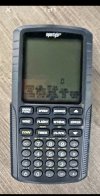
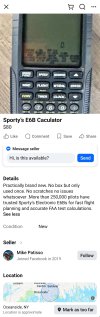
For Sale E6B & (2) Plotters -- Having a Little Fun with FaceBook Seller

I still have my metal (not cheap paper!) E6B that has its own pencil holder. And two plotters. One is an SP-7, sort of a half-sized version of the SP-4 in the photo. The other is a "Rapid Course," which was actually pretty cool. Two connected parallel clear rulers. You placed one on your course line and the other on a nearby VOR to read the radial and skip the true to magnetic calculation.

I wish I had kept my aluminum E6B from 1996. It would be a pretty cool display item to have on my desk. I bid on one on Ebay, but lost.
 
For our Mail Run we get a live briefing with paper handouts that include, weather, destinations, and a sheet to put your fuel and time gestimates on and return to the contest director.
 
K&E was the cool guys Slide Rule back in the day.

I actually had a class in Numeric Methods in Engineering that had a section that required you to design and make a special slide rule to solve a specific problem. You bought wooden blanks with the slides at the Campus Bookstore, Inked the scales with India Ink, glued then to the blanks and solved a problem. Mine was for excavation of a skyscraper foundation involving various capacity dump trucks, distance to travel, size of excavation and time required to complete the excavation IIRC.

The answer was how many trucks required to git-er-dun.

Next year HP came out with the fitst handheld calculator that sent slide rules to the dust bin of history.
Wasn’t that Circa 1952? :lol:
 
I had a slide rule almost identical to the one posted above and was told by my high school instructor I couldn't use it. Had to use long math only. I soloed in 1965 at 16 and used a circular E6-B that I still have but tried to relearn how to use about 10 years ago (for our Mail Run) and failed, bought a standard slider type as pictured above. Here at KFEP, once a year, we have a contest called the Mail Run. We are given 3 destinations to fly to, take a picture to prove we were there and end up back at KFEP. You have tell the contest director before you leave, your time enroute, to the second, and the fuel used, to the 10th of a gallon, then go fly the course. But; with no electronics! Nothing other than a map, compass, and a stop watch, or 3 stop watches as some use. And no electronics to flight plan either. Again just the E6B, a sectional, and a plotter. And it is truly challenging and fun! Winds aloft become critical to determine before you launch but also must be checked once airborne of confirm and make changes needs on the fly! The time in the air is typically around 1.5hrs.
sounds a bit like how we used to do glider competitions and record/goal flights to prove we were over the turnpoint.

Surprisingly my search for example photos was unsuccessful. Even tried to get ChatGPT to find an example photo and it struck out to. Here is what it did say about it.
--------------------------------------------------------------------------
in sailplanes we used to use cameras mounted to the canopy pointed to the side to take photos of turnpoints as we passed them. Can you find any online photo's of an example of this or the photo it might take showing the wing and the turnpoint (usually the end of a runway) below?

You’re remembering a very real (and now mostly historical) technique—turnpoint photography—and the geometry you described (wingtip + runway end in frame) is exactly how it was done.

What the setup looked like​

  • A fixed camera mounted on the canopy frame, pointing ~90° to the side and slightly downward
  • The wingtip deliberately included in the frame as proof of orientation
  • The pilot would bank so the wingtip “points” at the turnpoint and fire the shutter
This isn’t just anecdotal—training manuals explicitly describe it:

  • The camera is mounted so “the wingtip is visible in the photograph”
  • Typical aiming: point the wingtip at the turnpoint and shoot when it’s just ahead of it
  • Often angled slightly downward (~20°) so the ground feature (runway, silo, etc.) appears beneath the wing

What those photos looked like​

It’s surprisingly hard to find classic examples online (most pre-GPS badge flights weren’t widely digitized), but here’s a representative visual approximation based on actual geometry:

Typical view (similar composition, though not an actual turnpoint shot)​

These aren’t true turnpoint photos, but they help illustrate:

  • Long wing occupying the upper/side of frame
  • Ground features (runway, airfield, or landmark) below
  • Perspective you’d get from a canopy-mounted side camera

Mentally reconstructing the real turnpoint shot​

A true badge/competition photo would typically look like:

  • Wingtip in the upper corner
  • Runway (or target) just ahead of or slightly below the wingtip
  • Aircraft in a moderate-to-steep bank
  • Shot taken just after passing the turnpoint, inside the FAI photo sector
Pilots were essentially using the wingtip as a “gunsight” or bombsight to guarantee the feature was in frame


Why you don’t see these much anymore​

  • GPS loggers replaced photographic proof in most competitions and badge flights
  • Cameras are now used more for video than evidence
  • The old Instamatic/film workflows (sealed cameras, continuous film) are obsolete

​

 
Back
Top