Any DM Type 1's With Class III? Share Your Experience

GoogleWasMyIdea

Filing Flight Plan
Joined
Oct 6, 2025
Messages
4
Display Name
GoogleWasMyIdea
Hi All, new here and looking to hear stories/advice from anyone who is a Type 1 and how difficult it was to obtain your Class III, what hoops you had to jump through, obstacles you encountered and just your overall experience with your AME and the FAA. How long did it actually take? Call it a mid-life-crisis, but I am strongly considering trying to obtain my Class III to then pursue my PPC. I have talked with an AME who has some history in processing Type 1's with a pump/CGM like me, but with the FAA only recently (a couple years recent) accepting diabetics in general, I'm having trouble finding anyone who has gone through the process and been successful to hear about the process.

So if you have any history and are willing to share please post or reach out directly.
 
It's been more than a few years. It's been close to three decades now, going back before the modern CGM. Had a friend who had a onetouch glucose meter velcroed to the yoke of his Grumman. The protocol was drastically revised in the light of the advent of CGMs.

Actually, the FAA doesn't distinguish between type I or II, just whether you use insulin or not (which is typically all the type I and some of the type II).

You'll need 6 months of CGM showing control within their parameters. You'll need a A1C.

Then you'll need evals from an board-certified specialists:
endocrinologist (comprehensive report)
ophthamologist (retina health)
cardiologist (labs, EKG, and if over 40, stress test).

Best to find a good AME who has done this before to help you collect everything together.
 
Since UHC lost the suit and transdermal has become standard, and since if the agency knows you have a CGM, they are going to want to see it, The old 3rd class "no CGM" is slowing going away.

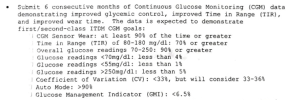
Have ~20 of these (issued). You just have to fill the squares. Hint: FAA hates lows<70. Be sure to take a readable but low res pic of your glucometer and pic EVERY one of them because 70% are not that low (becuase the transdermal glucose device isn't as accurate down low). And get the Coefficient of variation less than 33!!. Set your glucometer limits appropriately.

1759841772808.png

B
 
Last edited:
Since UHC lost the suit and transdermal has become standard, and since if the agency knows you have a CGM, they are going to want to see it, The old 3rd class "no CGM" is slowing going away.

Have ~20 of these (issued). You just have to fill the squares. Hint: FAA hates lows<70. Be sure tto take a readable but low res pic of your glucometger and pic EVERY one of them because 70% are not that low (becuase the transdermal glucose device isn't as accurate down low). And get the Ceofficient of variation less than 33!!. Set your glucometer limits appropriately.

View attachment 145867

B
Thanks for all that B! I received that info and "Target Ranges" from the AME I contacted. Since I have been following the ADA standards for care with an A1C at or less than 7%, I am changing my treatment to be somewhat more aggressive to meet these standards set by the FAA. I'm close, so should not be difficult, but I just have to wait longer to provide those readings that are within their standard ranges.

With that, if you have some history with this, the guidelines states to submit monthly CGM data for the proceeding 6 months (up to 12 months when available) and the AME I spoke with did not give me a clear answer, on this but will submitting only 6 months of data at time of application when I've had a CGM longer, cause them to request 12 months of data or deny the application? I know I can meet the target ranges over the next 6 months to submit, but if they ask for 12 months those readings will be out of the target range. So should I just wait till I have 12 months of data or would they accept the 6 months of data? Not sure if you have had specific experience with this or not, so just asking.

Thanks for the help!
 
It's been more than a few years. It's been close to three decades now, going back before the modern CGM. Had a friend who had a onetouch glucose meter velcroed to the yoke of his Grumman. The protocol was drastically revised in the light of the advent of CGMs.

Actually, the FAA doesn't distinguish between type I or II, just whether you use insulin or not (which is typically all the type I and some of the type II).

You'll need 6 months of CGM showing control within their parameters. You'll need a A1C.

Then you'll need evals from an board-certified specialists:
endocrinologist (comprehensive report)
ophthamologist (retina health)
cardiologist (labs, EKG, and if over 40, stress test).

Best to find a good AME who has done this before to help you collect everything together.
Thanks! Very interesting and thank gawd for CGM's I guess. I remember the days, before CGM, always checking my BS with a meter and the concept of having one velcroed to a yoke would make things interesting, to say the least!
 
I had a third class back in the pre-CGM days. Fingerstick every hour while in flight. It wasn't all that difficult, but without fail, every time I went to do one, I'd get a handoff or ATC would call traffic or something! I can't add anything to what the other posters said, except to note that Dr. Chien is an expert on this. He originated my third class, and has done a lot of them.

I switched to BasicMed as soon as it became an option, and would highly recommend you consider this following your initial class 3, if it will be compatible with the type of flying you want to do.
 
Thanks for that @BrianR ! That is great advice as I had not looked into the BasicMed yet and was just focusing on the Class 3, but will keep that in mind down the road after I get the Class 3.
 
Old Thread: Hello . There have been no replies in this thread for 365 days.
Content in this thread may no longer be relevant.
Perhaps it would be better to start a new thread instead.
Back
Top