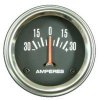
Ammeter reads zero..

jekyoonkim

Filing Flight Plan
Joined
Oct 6, 2017
Messages
5
Display Name
Jack Kim
When studying about the 3-unit voltage regulator troubleshooting, I got a question about the ammeter reads zero. The regulator has voltage regulator, current limiter, and reverse current cut out inside. When the operation is normal, I know that ammeter shows slightly more above than zero to the positive side. My instructor gave me question that what if ammeter reads ZERO? what could be the malfunction in the regulator?
 
And what answer did you give your instructor?


Welcome to POA.
 
It could be a lot of things. Voltage regulator, master relay, alternator, even the battery.
 
It could be a lot of things. Battery, alternator, master relay, even the voltage regulator.

Not to mention the ammeter itself.
 
I’d just tell the instructor it could be broke. It’s not like the electronic regulators can be fixed like the old ones could be sorta be fixed by dressing contact points.

Now if the instructor is wanting to hear over-voltage relay that is a slightly different story.

For the guys making lists of what might be wrong don’t fergit the drive coupling or belt.
 
Is the engine running? :popcorn:
 
It could be many things, the battery, voltage regulator, master relay, alternator or even the ammeter itself.
 
Unfortunately, some ammeters read very near zero under normal conditions, when the alternator is not charging the battery, so it can be hard to tell. Some airplanes have a low voltage light to indicate a problem.
 
I’d just tell the instructor it could be broke. It’s not like the electronic regulators can be fixed like the old ones could be sorta be fixed by dressing contact points.

Now if the instructor is wanting to hear over-voltage relay that is a slightly different story.

For the guys making lists of what might be wrong don’t fergit the drive coupling or belt.
You mean the broke for the ammeter?
 
Hi.
A zero, or close to zero, is a normal condition in a running acft where the battery is fully charged and the source / alternator / generator is capable of supporting all the load imposed on it at the time.
 
Hi.
A zero, or close to zero, is a normal condition in a running acft where the battery is fully charged and the source / alternator / generator is capable of supporting all the load imposed on it at the time.
That's why I installed a voltmeter. The cheap ammeter in my plane reads close to zero in normal operation. The voltmeter shows system voltage and 14.1 V is what you want to see.
 
Thank you so much! Umm.. didn’t answered him yet. Still finding the answer lol. Thinking about the spring at the current limiter too. Is that might be the problem?
Most of the electromechanicals are out of the fleet. Even with the electromechanical regulators on cars it was usually the relays. Springs usually aren’t a problem in this type of service.
 
If your ammeter is reading zero, turn on a large load (landing light, etc) and watch the meter closely. When the load is turned on, the ammeter should dip to the negative side momentarily and then quickly return to zero.

If you have a load meter instead of an ammeter, a zero reading indicates no alternator output. Load meters are found on Pipers, and a few other manufacturers' planes.

-Skip
 
You mean the broke for the ammeter?
If an instructor ask me what could be wrong with a voltage regulator I’d just tell him it could be broke. It’s not like I’m going to fix it in the air. Maybe cycle the master to reset everything (if no breakers have popped or fuses burned, no smoke, etc.). Load shedding is a real good idea at first sign of a charging system problem.

In the air we really don’t know what has failed. The ammeter may not show much. A volt meter will tell you more. You can try things like turning on a non-led landing light or pito heat to see if there is a discharge (won’t work on a PA-28). All you can really determine is that something isn’t right and maybe you’d better go land somewhere.

Of course I’m assuming no smoke or indication of a fire. If that happens kill the master and land. Landing might be immediately if the fire doesn’t go out. Land at nearest airport if the fire goes out.

Now if you’re training for A&P the conversation is just a bit different...
 
If the alternator / regulator pooped out, you should show a discharge, not zero.

Except, of course, for the fact that the ammeter may be so numb that you really can't tell.
 
One way to get zero would be if the wiring to the gauge is broken?
 
And it seems that we are completely ignoring the fact that different aircraft manufacturers use ampmeters in different ways. :dunno:
So while a 0 reading is desired in one airplane, it is undesired in another.

OP, I'd follow up your instructor's question with another question: "which airplane?" :)
You need to know your systems. And they are not all identical, btw.
 
When studying about the 3-unit voltage regulator troubleshooting, I got a question about the ammeter reads zero. The regulator has voltage regulator, current limiter, and reverse current cut out inside. When the operation is normal, I know that ammeter shows slightly more above than zero to the positive side. My instructor gave me question that what if ammeter reads ZERO? what could be the malfunction in the regulator?

If it's reading zero, the master is turned off.

It should show a slight charge when things have stabilized. That's the trickle the battery takes even when it's fully charged. If the generator has quit, it should show whatever draw (discharge) all the operating systems are taking. And a three-unit regulator is for the generator; the alternator takes a two-unit regulator. The generator needs the reverse-current cutout (no diodes in it like the alternator) and the current limiter, because the generator is usually too small to to carry all the loads at the same time. The alternator has far more capacity and doesn't need that.
 
Back
Top