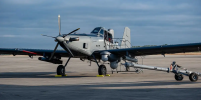
Air Force OA-1K Skyraider II Down, OK City, 10/23/25

The included video is a Piper crash landing on a golf course, unrelated to the story. But is an airplane crash landing....

The text and pictures of damaged power poles are probably true local coverage.
 
Story was amended to note aircraft and crew are active duty USAF, not OKANG.

Good job by the crew, with a mild chide for not avoiding the wires. But rough fields is what this aircraft was built for.

I know a young man currently winding his way through the Air Force pilot training pipeline. He says this aircraft is a popular choice among aspirants.
 
Last edited:
I know a young man currently winding his way through the Air Force pilot training pipeline. He says this aircraft is a popular choice among aspirants.
Not sure how so, given this AFSOC assignment is not fully missionized as of Fall of 2025. I don't pay close attention to the T-6 drops, but haven't heard any O-1Ks dropping out of pilot training. Open to stand corrected of course.
 
Unrelated to the accident but flew a 4 day with a guy whos an instructor in the program and his take is that its a pretty dumb aircraft and questionable mission. Speed, survivability, and alternatives that would work better were all common points when we had another mil guy in the jumpseat.
 
Not sure how so, given this AFSOC assignment is not fully missionized as of Fall of 2025. I don't pay close attention to the T-6 drops, but haven't heard any O-1Ks dropping out of pilot training. Open to stand corrected of course.

Had a guard baby (pretty sure…) a week or so ago heading to these… pretty cool!
 
Not sure how so, given this AFSOC assignment is not fully missionized as of Fall of 2025. I don't pay close attention to the T-6 drops, but haven't heard any O-1Ks dropping out of pilot training. Open to stand corrected of course.

I probably misspoke. He told me he and his friends all thought it would be a cool plane to fly. That's all.
 
Civilian did a great job of steering *behind* the impending crash like more people should.
Steer to the rear was hammered into us during law enforcement driver training. It saved my butt on a motorcycle (personal - wasn’t lucky enough to work for a department that had motors) when an oncoming car made a sudden left turn.

Same thing with animals. They almost always go forward, so steer to the rear when one is coming across the road in front of you.
 
Unrelated to the accident but flew a 4 day with a guy whos an instructor in the program and his take is that its a pretty dumb aircraft and questionable mission. Speed, survivability, and alternatives that would work better were all common points when we had another mil guy in the jumpseat.

I'd probably agree with his take. I mean, there could certainly still be mission sets in the future that beg for an aircraft like this, but it stinks like the 20 yr old requirements for an early OEF "COIN" aircraft, that became its own slow-moving, mostly unsuccessful, acquisitions rice bowl just like anything else from the GWOT. Yesterday's requirements drive tomorrow's programs......or something like that.
 
I'd probably agree with his take. I mean, there could certainly still be mission sets in the future that beg for an aircraft like this, but it stinks like the 20 yr old requirements for an early OEF "COIN" aircraft, that became its own slow-moving, mostly unsuccessful, acquisitions rice bowl just like anything else from the GWOT. Yesterday's requirements drive tomorrow's programs......or something like that.

As someone who spent a career as a customer for this type support, I'll argue the counterpoint. The GWOT isn't going away. Troops are still in contact in Syria, and in several far flung spots in sub Saharan Africa. That kind of combat will remain more likely than a peer fight.
Having an option for air support that doesn't require a massive air base can make the difference between a viable operation and a non-viable one. The SF ambush in Niger in 2017 is a good example of a use case where this kind of platform might have made a difference.
Having said all that, kudos to DoD for turning a $2M aircraft into a $40M one.
 
I listened to a podcast where someone in the know explained why this airplane came to be. When there are small teams of special forces guys doing their thing, it's very hard to get airborne support, because an F-whatever needs a lot of infrastructure. The OA-1K can fit inside a C-5 (maybe even a C-17) and does not need nearly the amount of infrastructure that a fighter does. Obviously it is not built for contested airspace, but it can provide surveillance and armed support for the snake eaters.
 
Don’t forget A-10s. We won’t talk about the ABCCC capsules though.
Well, theoretically all the SOCOM stuff could be done with Ospreys. I mean they’re taking over the COD mission for the Navy. Heck, put a radar on top and get rid of the E-2s as well. :p
 
Don’t forget A-10s.
At least the A-10 has an ejection seat.
I'm sure the drivers will have a warm and fuzzy feeling knowing they've got airbags...

Odd that a PT6-A failed, obviously will be a while before we know why.
That plane is a beast- 1,600 shp with an empty weight under 8k and gross of twice that.
 
As someone who spent a career as a customer for this type support, I'll argue the counterpoint. The GWOT isn't going away. Troops are still in contact in Syria, and in several far flung spots in sub Saharan Africa. That kind of combat will remain more likely than a peer fight.
Having an option for air support that doesn't require a massive air base can make the difference between a viable operation and a non-viable one. The SF ambush in Niger in 2017 is a good example of a use case where this kind of platform might have made a difference.
Having said all that, kudos to DoD for turning a $2M aircraft into a $40M one.

I agree with your points, particularly the last sentence, which was really what I was getting at.
 
From a non mil guy but just talking to them.
1. Its slow 200kt top speed throw some pods and weapons and Id say your looking at 150kts
2. Wont be able to operate in a contested environment its a big slow target with very limited altitude capability
3. Uses two very expensive crew a pilot and CSO. Lack of ejection seats mean loss of crew if it takes damage that renders it uncontrollable, plus the mental stuff of knowing your always along for the ride.
4. Doesn't really do anything better than existing platforms. A helo is just as fast, requires less room to operate out of, can be transported in aircraft easier, a drone can loiter longer with the same weapon set and without the loss of crew, a jet can cover much more ground and respond quicker with a more diverse weapon set.
5. Future use in a personal drone environment. racing drones can exceed 200mph. I imagine china/iran have the tech or wouldnt take much to create something that renders a platform like this obsolete. Racing drone upsized a bit, targeting doesn't need thermal or radar heck my 20 dollar Chinese camera for bird watching the feeder can activate and track movement. Some custom software and such a drone would be set and forget. So 5 -10 years from now I doubt you could even operate against the cartels cause a 1k$ (or even 10k) drone or 50 drones to take out a 40 million dollar platform and more importantly 2 flightcrew would be well worth it. I imagine that china/iran would be more than willing to supply such a drone to various entities zero training required (make sure its charged hit the arm button, make sure the targeting camera is pointed skyward, wait for the beep and hit launch) no radio signal to jam, its all enclosed, whoever's launching it doesn't have to worry about friendly fire cause they have no other airborne assets .


This seems like a political plane 20 years too late, and 20 million too expensive.
 
yeah, it's likely not to scale, this is some COIN ballwash from the last war, SOCOM will always grift for new toys. Wouldn't be surprised if it has the life cycle of the MC-12 program, maybe less. I don't see it even scaling to MC-12 inventory levels at their peak.

The big COIN capitalization questions were mulled over during the A-29/AT6B research programme days. It largely went nowhere. This thing's a nothingburger. In fairness, it's not the worst capitalization grift/blunders the MIC has commited. I could mention a few way worse offenders, but the fanbois will get triggered and I don't care to talk shop this close to retirement anymore anyways.
 
4. Doesn't really do anything better than existing platforms.

Is it supposed to replace existing platforms? Or is it supposed augment existing missions which cannot justify better, more expensive air support? Putting a bad tank with an infantry unit that would otherwise have no tank can be beneficial to that unit.
 
Yeah this thing isn’t intended to replace anything. It’s the present day Skyraider. Now the natural rebuttal to that is, “this ain’t Vietnam anymore.” I completely disagree.

OEF and OIF were very much like the Vietcong situation in the Vietnam War. If anything, this type of airframe would have been even more effective than the Skyraider because we had an even lesser ADA threat than Vietnam. Once you eliminate the ADA threat as the AF / Navy did in Iraq, what do you have? A occupying force dealing with guerrilla warfare. That environment is perfect for something like this. As @Ed Haywood stated, you had a lot of special ops where slow moving CAS can be more effective than higher altitude fast movers. I saw first hand how an Apache can send a Hellfire through a window in a couple minutes vs a Bone taking over an hour to get approval for a JDAM…ROE. Reducing collateral damage is always a priority and we got several policy letters basically saying we’re killing too many civilians. “Proportional response.”

Now, the drone argument is valid but I haven’t seen any drones with the range, armament or the SA to go out and perform this type of mission. Survivability against Kamikaze drones could be a real issue but I haven’t seen them effective against manned aircraft (airborne) yet. Heck, even manned aircraft not designed to counter swarms of kamikaze drones can still hold their own today.

 
Last edited:
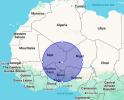
The Tongo Tongo Ambush was a big impetus for the capability. TLDR: a 10 man Special Forces team was ambushed by a larger Jihadi force while advising a Niger government unit during a visit to a remote village. The team got separated and one element was overrun by the enemy, with 4 killed and 2 wounded. One big takeaway from the ensuing hearings was that they were well beyond any US capability to support them with ISR and CAS. The blue circle below is a 500 mile radius from the site of the ambush.

Tongo Tongo.PNG

The idea behind the Skyraider II was to develop a platform with the bare minimum footprint necessary to extend that capability wherever needed. No 12,000 foot runways, no aerial refueling, no base defense forces, no construction, no major maintenance facilities. No gym, no chow hall, no CORIMECs, no mayor, no Bagram or Balad.

The Skyraider wasn't built to fight the Russians or the Chinese. It was built to fight these cats:

ISGS.PNG
 
The Tongo Tongo Ambush was a big impetus for the capability. TLDR: a 10 man Special Forces team was ambushed by a larger Jihadi force while advising a Niger government unit during a visit to a remote village.

The idea behind the Skyraider II was to develop a platform with the bare minimum footprint necessary to extend that capability wherever needed. No 12,000 foot runways, no aerial refueling, no base defense forces, no construction, no major maintenance facilities.

The Skyraiders should operate in teams of 2 or 4, depending on the mission. That was Vietnam standard procedure. You want to cover your buddy while he pulls up after a run. Parallel racetracks for both teams covers the area pretty much. If you're down in an LZ flying a slick the guns would ask: how close do you want the rockets? On occasion you would get shrapnel but glad of it.

USAF smart to build good commo and connectivity into the new plane.
 
Yeah this thing isn’t intended to replace anything. It’s the present day Skyraider. Now the natural rebuttal to that is, “this ain’t Vietnam anymore.” I completely disagree.

OEF and OIF were very much like the Vietcong situation in the Vietnam War. If anything, this type of airframe would have been even more effective than the Skyraider because we had an even lesser ADA threat than Vietnam. Once you eliminate the ADA threat as the AF / Navy did in Iraq, what do you have? A occupying force dealing with guerrilla warfare. That environment is perfect for something like this. As @Ed Haywood stated, you had a lot of special ops where slow moving CAS can be more effective than higher altitude fast movers. I saw first hand how an Apache can send a Hellfire through a window in a couple minutes vs a Bone taking over an hour to get approval for a JDAM…ROE. Reducing collateral damage is always a priority and we got several policy letters basically saying we’re killing too many civilians. “Proportional response.”

Now, the drone argument is valid but I haven’t seen any drones with the range, armament or the SA to go out and perform this type of mission. Survivability against Kamikaze drones could be a real issue but I haven’t seen them effective against manned aircraft (airborne) yet. Heck, even manned aircraft not designed to counter swarms of kamikaze drones can still hold their own today.


Good points. And my buds who are still out on the pointy end of the spear, have told me that **** in the GOO, Red Sea, Arabian Gulf has gotten a lot more high end......ie not survivable for a platform like this anymore, at least if you don't know what you're doing or unlucky. I guess I'd leave it at that, but this isn't Africom (or AFG) ops of 10-20 yrs ago.
 
Having an option for air support that doesn't require a massive air base can make the difference between a viable operation and a non-viable one.

I listened to a podcast where someone in the know explained why this airplane came to be. When there are small teams of special forces guys doing their thing, it's very hard to get airborne support, because an F-whatever needs a lot of infrastructure. The OA-1K can fit inside a C-5 (maybe even a C-17) and does not need nearly the amount of infrastructure that a fighter does.

The idea behind the Skyraider II was to develop a platform with the bare minimum footprint necessary to extend that capability wherever needed. No 12,000 foot runways, no aerial refueling, no base defense forces, no construction, no major maintenance facilities. No gym, no chow hall, no CORIMECs, no mayor, no Bagram or Balad.

I agree with those saying the OA-1K is the wrong platform, and the mission set is dubious as currently defined. Related, the idea of something like the OA-1K needing "reduced infrastructure" always seemed a little questionable to me.

People paint a picture of a 4-ship of these "fighting the good flight" out of a dirt airstrip in the jungle/desert somewhere. But the reality is different. You start hanging munitions off of it, you need some level of ground support for that. Sophisticated sensor balls, more support needed. Not to mention the care and feeding of a turboprop-equipped aircraft. You're talking about a lot of people to support all of that, and a lot of infrastructure to support those people.

It's like all of stuff that went into the A-10 to enable operations from unimproved airstrips. It enables some cool exercises flying off of highways and the like, but in actual wartime, the A-10s were operating out of the same big airfields as everyone else.

IMHO, the mission set required a jet-equipped aircraft with long range, long endurance, with a lot of sensors, and a lot of weapons. But the end result of that development starts to get close to the operating space of existing programs (F-35, etc). And the acquisitions mafia is strong, the powers that be (Lockheed, etc) don't want anyone encroaching on their existing territory.

The fact that the OA-1K actually made it into production in spite of all of this is amazing. However, the vultures have already been circling. The original order of 75 was reduced from 62, and organizations like the GAO have been pushing to slow the acquisition. I speculate that it's likely to head down a similar path as the C-27J - an airframe the Air Force didn't want, forced into the ANG for several years before being retired.
 
Last edited:
Turns out it is quite the pricy beast, with a markup percentage over the bare airframe challenging that of the VC-25.
 
Back
Top