AD and STC binder

Ed Haywood

Final Approach
Joined
Jul 12, 2020
Messages
7,624
Location
Tampa FL
Display Name
Ed
Home Airfield
FD77
My logs are well organized. Now time to build an AD and STC binder. Any tips on the best way to go about that?

 
I keep 3 separate binders because it’s way too much paper. August 20, 2026 will be the 50th anniversary of its maiden test flight at Cessna.

-I have one of those big soft zippered 3 ring binders. I have individual plastic 3 hole pouches in it that hold different things - individual STCs and their ICAWs, prior W&Bs, and all the AD stuff. It also includes a CD of when I did the FAA records search. Also a thumb-drive of the POH and service manuals. Also an appraisal from a few years back.
-I keep a separate binder for old (full) log books, including prior oil analysis reports.
-And a small leather case for the 3 active log books.

I think it’s over the top, but I also have individual ziploc bags of my paper oil filters labeled with the date of the filter/oil change. I have room in the hangar so why not. Maybe it’ll bring me an extra $5 at resale…

Crazy I am.
 
individual STCs and their ICAWs,

What docs do you keep for STC? Did you get the 337's from the FAA?

prior W&Bs

Is it a requirement to have the full W&B change history from the last weigh in?

all the AD stuff.

What documents do you keep in your AD folder? Full copy of each, or just a summary list with reference to where logged for compliance?

Do you have a particular search source that you recommend?
 
Mine is a big enough binder to have tabbed sections for ADs and 337s. Keeping everything together makes my AI’s life easier.
 
Last edited:
What docs do you keep for STC? Did you get the 337's from the FAA?


Is it a requirement to have the full W&B change history from the last weigh in?


What documents do you keep in your AD folder? Full copy of each, or just a summary list with reference to where logged for compliance?

Do you have a particular search source that you recommend?

Any 337s that were filed I have on the CD from the FAA search that I did pre-purchase.

I have a paper copy of the ST Cerificate, and any attachments. The Instructions for Continued Airworthiness as well.

I think you can toss the prior W&Bs. I had some from the prior owner and it was cool to see when prior equipment was added or taken away. The old ones have a pen cross-thru.

The AD stuff is just a list from my A&P when they did their search, not the actual AD text/requirements. I forget which search source they use. I think it actually starts with “AD something”.
 
Check out ADLog. https://adlog.com/
Everything is contained in a single binder with heavy dividers. Get the biggest binder they offer. Service Letters and Bulletins are not included in the service, only Airworthiness Directives. They determine which ADs are potentially applicable to your plane because you give them, tailnum, manufacturer, model, and serial number. And you can add your own STC section.


Binder separators are:
General Information
Aircraft Inspection Status
Airframe log
Engine log
Propeller log
Avionics
Applicable Airworthiness Directives
ADs Permanently Complied With
ADs Requiring Additional Compliance
Major Alterations & Alteration Forms (FAA Form 337)
Weight & Balance Papers
Factory Service Notes or Bulletins
Maintenance Release or 8130-3 Forms
Oil Analysis

There is an initial setup fee of $160-180 (depending on the size of the binder), with yearly subscription of $36. If you save your A&P-AI an hour of time, the subscription is more than paying for itself.

One of the setup steps for converting to ADLog is to put a last entry in each separate logbook stating: "See ADLog System Log No. <num> for further entries after <date>"

I had two Airframe, two Engine, and one Propeller Logbook. So, <num> was '3' for Airframe and Engine, and '2' for Propeller.

Another thing you should seriously consider is getting the history CD on your plane from the FAA. For $10 they give you everything they have which includes all title transfers, major alterations, registrations, 337s, STCs ...


I was surprised by what was there. Some of it was logged, some not, and there was an previously unknown owner.
 
I keep a copy of the actual type certificate in the binder too. Basically, original plus changes.
 
I just tried to buy my 337 CD from the FAA. Talk about a dated website. Of course the transaction did not go through. Maybe I could get the documents written on papyrus scrolls or carved into a little stone pyramid and sent to me by canoe?
 
Is it a requirement to have the full W&B change history from the last weigh in?
While not a requirement, I think it’s a good idea. I’ve had to go back through at least 3 superseded Weight and Balances to determine that a calculation error was made, and that we were, in fact, outside the envelope. And I’ve headed that off a few times in subsequent airplanes by reviewing superseded Weight and Balances.
 
My logs are well organized. Now time to build an AD and STC binder. Any tips on the best way to go about that?
I’m an A&P. 25 years ago when I was working my off days at an FBO. The FBO had access to an online program.

The boss’d have me write down every part number and serial number of anything I could find a number on.

We’d print out a sheaf of papers that had every SB/AD for everything installed on the aircraft, which fell into a couple of categories airframe/accessories, Powerplant, and propeller.

The program would print the AD number, a brief description. There was a set of boxes to indicate
N/A not equipped,
N/A part number or serial number
PCW Previously Complied With no further action required
C/W by __________ (removal/replacement/other action) and there was a block for indicating recurring action was required.

By the time we were done we had a 3 ring binder and several sections separated by tabs that had pages full of clearly spelled out the Ad/SB its associated number and status that became the airplane owners property.

When that airplane came back the following year, we had a roadmap and a checklist. That part of the annual inspection narrowed to what has been changed (removed or replaced) were there any new AD/SB’s?
 
All aircraft airworthiness forms can be downloaded on CARES in pdf format. For free.
IF you have not requested to withhold your ownership data from public dissemination. Otherwise, buying the CD is the only option.
 
I use the AdLog system. It not only lists the ADs for your plane, it also includes the text of the AD so it’s all right there in the same binder and easy to look up. Plus it includes what seems like every possible AD, even those that don’t apply to your airframe.

My A&P was happy that I got AdLog, and accepts their AD search and recording.
 
All aircraft airworthiness forms can be downloaded on CARES in pdf format. For free.
How does one do that? I just went to CARES and it sent me to the old site that has options for CD or paper. I didn't see an option for PDF downloads on CARES.
 
How does one do that? I just went to CARES and it sent me to the old site that has options for CD or paper. I didn't see an option for PDF downloads on CARES.
I don’t have my computer in front of me, when I get home I’ll walk you through it.
 
How does one do that? I just went to CARES and it sent me to the old site that has options for CD or paper. I didn't see an option for PDF downloads on CARES.

1) Sign in
2) Once in, go to the tab on the left. Under your name, click "Get Started"
3) Select aircraft services
4) Search/Request Aircraft Records
5) Enter N number
6) Under Documents, you can select Registration, Airworthiness or Suspense
You can download the pdf's to your PC.
 
1) Sign in
2) Once in, go to the tab on the left. Under your name, click "Get Started"
3) Select aircraft services
4) Search/Request Aircraft Records
5) Enter N number
6) Under Documents, you can select Registration, Airworthiness or Suspense
You can download the pdf's to your PC.
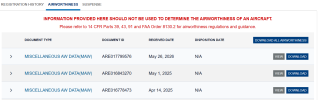
Thanks, that's the sequence I followed. But when I get to step 6 it provides:
1785558694948.png

If I select "Request a Complete Copy" then it takes me to the order page for CD or Paper. I don't see and option for PDFs.
 
Thanks, that's the sequence I followed. But when I get to step 6 it provides:
View attachment 153924

If I select "Request a Complete Copy" then it takes me to the order page for CD or Paper. I don't see and option for PDFs.

When I pull them up, say on my registration number, I can see the individual files.

Try this, request a different N number and see if it shows the individual files.

You should see this:

1785583690990.png
 
Thanks, that's the sequence I followed. But when I get to step 6 it provides:
View attachment 153924

If I select "Request a Complete Copy" then it takes me to the order page for CD or Paper. I don't see and option for PDFs.

Do you have your aircraft information blocked from public viewing? I have heard if that's done then access to records can't be made.
 
Do you have your aircraft information blocked from public viewing? I have heard if that's done then access to records can't be made.
I do, that could explain it. I wonder if they would still send out the records via CD or paper to other than the registered owner in that case?
 
I do, that could explain it.
That does explain it. See post #13.

The top of the page should have this verbiage:
“The Registered Owner has requested to keep some data private under Title 49 of the United States Code Section 44114.”
 
'cause keeping records of oil changes on an engine that's no longer in the aircraft is ?????

All that extra garbage is the reason IA's / AnPs take so long to review logs. No one cares what the compression results on an annual were from 1975 when that engine is no longer installed/rebuilt.

One thing that does baffle me and I would like to hear answers from owners is why do you not keep a list of annual discrepancies? I mean we're talking about value and safety but just because a list of unairworthy items is given to the owner does not mean that they were corrected. Since the ACTUAL unairworthy items are no listed in the annual log entry. 43.11(5)

This seems to be a GLARING error in the process and the FAA turns a blind eye towards. The FAA has the retarded mentality of 'log the cylinder compressions' but not 'list the unairworthy items that pose a safety risk'. So an owner can (and I will go out on a very short limb) and dare say that they have, simply thrown that list in the trash.
 
One thing that does baffle me and I would like to hear answers from owners is why do you not keep a list of annual discrepancies? I mean we're talking about value and safety but just because a list of unairworthy items is given to the owner does not mean that they were corrected. Since the ACTUAL unairworthy items are no listed in the annual log entry. 43.11(5)
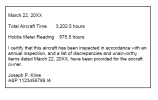
So, if the IA signs off an annual inspection with a list of discrepancies his sign off should read:

1785672136315.png
Now if the owner needs to fly the aircraft to another location to have these items fixed, he will of course need a SFP. And that SFP will require a logbook entry by an A&P to complete.

So if the owner does not give the list to an A&P to complete (fix these items) the aircraft remains unairworthy. Once the items are completed the A&P signs them off and this returns the aircraft to service.

Since maintenance is the responsibility of the owner it is incumbent upon that individual to see that all of these items are repaired and properly signed off.

Now let's say one of those items is an issue of great expense the owner would rather not have done. He directs the A&P to skip that item and fix the rest. If the owner starts operating the aircraft he is in violation, not the A&P and not the IA that signed the inspection.

Let's say that owner many months later has an incident and during a record review it's discovered he did not comply with the item in question. How could that be discovered? An ASI doing the logbook review calls the IA that made the last inspection and ask for the list of discrepancies and the IA happily obligies.

We could do a few more scenarios but you get the idea.

This seems to be a GLARING error in the process and the FAA turns a blind eye towards. The FAA has the retarded mentality of 'log the cylinder compressions' but not 'list the unairworthy items that pose a safety risk'. So an owner can (and I will go out on a very short limb) and dare say that they have, simply thrown that list in the trash.

See my example above. If the owner tosses that list in the garbage they are now in violation of 14 CFR Part 91. 405

91.405 Maintenance required.​


Each owner or operator of an aircraft—


(a) Shall have that aircraft inspected as prescribed in subpart E of this part and shall between required inspections, except as provided in paragraph (c) of this section, have discrepancies repaired as prescribed in part 43 of this chapter;

(b) Shall ensure that maintenance personnel make appropriate entries in the aircraft maintenance records indicating the aircraft has been approved for return to service;

Not sure how you are equating the FAA has turned a "blind eye" towards the process as it's explicitly written out in guidance and regulations.
 
I forgot to add that there is no requirement the discrepancy list be a separate document. I wrote the list out in the logbook below the inspection signoff and other IA's I have worked with did the same.
 
There most definitely is a requirement for a separate document for discrepancies. The list is provided to the owner and is signed and dated.

The logbook entry gives a standard blurb for an annual with discrepancies. It also states that a list has been given to the owner. I have not met any IA that deviates significantly from the 'blurb' as its the safest way to ensure compliance and avoid liability. I'm sure there are some that alter it a bit, but not significantly/list the deficiencies.

Since broken parts are not required to be logged in a book, only work performed and RTS, or a MEL under 91.213. While in commercial-land a logbook 'open discrepancy' will 100% take a plane out of service, non-commercial Pt 91 doesn't have that requirement.

I would hope an owner is not giving up the actual log books, and I also would not recommend that IAs have access to write in the logbook for the reasons listed above. 1. Owners should filter 100% of what is entered in the logs, as a sloppy entry still falls on them to correct, 2. its not required. 3, IA can be very subjective and place an undue burden on owners re: 'I don't like that' from IAs that don't have a basis in airworthiness.

I still maintain the 'discrepancy' list is ripe for abuse. First, not all AC will need to be flown after an annual so they don't require a SFP. Just roll them back to their hangar. How many IAs do an annual in a customers hangar? An owner can log an PM entry that can clear a discrepancy, so while it may not fix the issue per the manufacturers AMM/IPC, it does show that *something* was fixed, and without an officially 'logged' list no one will ever know what the other 15 items were other than the IA who has not duty to follow up.

I can come up with a dozen more ways to abuse the 'discrepancy list' process in its current form. And by seeing some of the AC people fly I can tell that either not every issue is discovered, or the ones that are are not properly rectified.

I pity the owners that fly certified AC.
 
There most definitely is a requirement for a separate document for discrepancies. The list is provided to the owner and is signed and dated.
While 43.11 says "that persons must give the owner or lessee a signed and dated list of those discrepancies." what they are referring to is not to include the list as part of the inspection sign-off. That list may appear directly below the inspection sign-off, no requirement to put into a separate piece of paper. You are misreading 43.11
The logbook entry gives a standard blurb for an annual with discrepancies. It also states that a list has been given to the owner. I have not met any IA that deviates significantly from the 'blurb' as its the safest way to ensure compliance and avoid liability. I'm sure there are some that alter it a bit, but not significantly/list the deficiencies.
The "blurb" as you put it says a list was given, it doesn't use the word "separate" as it's not required. If the IA was actually concerned that this owner would somehow toss the list or refuse to fix certain items, putting the list below the inspection sign-off would insure against this.
Since broken parts are not required to be logged in a book, only work performed and RTS, or a MEL under 91.213. While in commercial-land a logbook 'open discrepancy' will 100% take a plane out of service, non-commercial Pt 91 doesn't have that requirement.
And what about 91.205?

The above statement makes no sense and once again shows your lack of knowledge in general aviation operations and even air carrier. On the air carrier side, yes an airplane can have an open discrepancy and still be able to operate if that discrepancy is covered by an approved MEL. That's the purpose of the Minimum Equipment List.

And very few Part 91 GA aircraft (recreational, single engine and light twin) have MEL's assigned. And somehow you are insinuating that Part 91 aircraft can simply operate with broke or inop items at the owner's discretion. Not quite that simple.

I would hope an owner is not giving up the actual log books, and I also would not recommend that IAs have access to write in the logbook for the reasons listed above.
Giving up? How about providing? How is the IA suppose to complete the inspection without access to the logbooks?
1. Owners should filter 100% of what is entered in the logs, as a sloppy entry still falls on them to correct, 2. its not required. 3, IA can be very subjective and place an undue burden on owners re: 'I don't like that' from IAs that don't have a basis in airworthiness.
Again, you clearly don't understand how this works, which is not surprising. I doubt seriously you have ever been a part of the process where a plane is signed off and a discrepancy list is given. And apparently the VoTech you attended recently didn't cover this area in detail.
I still maintain the 'discrepancy' list is ripe for abuse. First, not all AC will need to be flown after an annual so they don't require a SFP. Just roll them back to their hangar. How many IAs do an annual in a customers hangar? An owner can log an PM entry that can clear a discrepancy, so while it may not fix the issue per the manufacturers AMM/IPC, it does show that *something* was fixed, and without an officially 'logged' list no one will ever know what the other 15 items were other than the IA who has not duty to follow up.
Again, without any working knowledge on the subject you are just moving goal post around.

Please tell us the time you were involved with an inspection that was completed with discrepancies and the owner abused it?
I can come up with a dozen more ways to abuse the 'discrepancy list' process in its current form.
You can make those assumptions because none are based in reality.
And by seeing some of the AC people fly I can tell that either not every issue is discovered, or the ones that are are not properly rectified.
And how do you link that to the discussion at hand? Did you have knowledge those aircraft were inspected and the owners were given discrepancy list?
I pity the owners that fly certified AC.
iu
 
My logs are well organized. Now time to build an AD and STC binder. Any tips on the best way to go about that?
Check out MyTailLog as an addition/backup for those. I recently added the option to upload scans of STCs, 337s, and other types of documents to the records vault.
That's, of course, on top of the regular logs (airframe, engine, prop, avionics), which get digitized, turn into a searchable database, and help you track and forecast maintenance.
 
Back
Top