I have a few questions. Why do wings have a lower camber? Wouldn’t that just decrease the pressure differential between the top and bottom? I know in a training setting it’s important, but in normal flight due you always do a full preflight and W&B and performance calculations? I assume a preflight is important, but do you have to do W&B and performance if the weight of the aircraft is around the same as usual, and you have plenty of runway for any conditions? Lastly, how do you avoid exceeding g limits on an aircraft? How do you know you are going to? If you are flying lower than Va does that mean any and all control deflections will not overstress the airplane? For example, if you’re pulling up from a stall, of course you’re well below Va, if you pull all the way back, can you damage the airplane, or is it impossible since you’re below Va? You certainly feel some Gs during that. What about in turns when load factor is increased? How do you avoid overstressing it then? If you’re below Va does that mean you can turn at any bank and not damage it?

You are using an out of date browser. It may not display this or other websites correctly.
You should upgrade or use an alternative browser.
You should upgrade or use an alternative browser.
A few questions
- Thread starter bdoss2006
- Start date

Dana
Final Approach
Flat bottom airfoils are also common, but they have more drag than a convex lower surface.I have a few questions. Why do wings have a lower camber? Wouldn’t that just decrease the pressure differential between the top and bottom?
It depends on the aircraft and how you load it. I haven't needed to do a full W&B on any of the airplanes I've owned over the last 40 years, as as long as I don't exceed the baggage weight limitation it won't be overweight or out of CG limits with any passenger or fuel load. However, these are all one or two seaters; with 4 seat airplanes you often have to trade passenger and/or baggage weight for fuel.I know in a training setting it’s important, but in normal flight due you always do a full preflight and W&B and performance calculations? I assume a preflight is important, but do you have to do W&B and performance if the weight of the aircraft is around the same as usual, and you have plenty of runway for any conditions?
At Va or below the aircraft will stall before you can exceed the g limits. Above Va you need to be more careful.Lastly, how do you avoid exceeding g limits on an aircraft? How do you know you are going to? If you are flying lower than Va does that mean any and all control deflections will not overstress the airplane? For example, if you’re pulling up from a stall, of course you’re well below Va, if you pull all the way back, can you damage the airplane, or is it impossible since you’re below Va? You certainly feel some Gs during that. What about in turns when load factor is increased? How do you avoid overstressing it then? If you’re below Va does that mean you can turn at any bank and not damage it?

Half Fast
Touchdown! Greaser!
- Joined
- May 7, 2016
- Messages
- 21,187
- Location
- Central Florida
- Display Name
- Half Fast
- Home Airfield
- KGIF
but in normal flight due you always do a full preflight and W&B and performance calculations? I assume a preflight is important, but do you have to do W&B and performance if the weight of the aircraft is around the same as usual, and you have plenty of runway for any conditions?
If I'm loading the plane in a similar way to what I've done (and calculated) previously, there's no need to do a new W&B. OTOH, my plane tends to be nose heavy, so when I'm loading up for a trip and maybe taking other people, I'll run a W&B with my planned take-off fuel and with zero fuel to make sure it stays within the envelope for the whole flight. If I'm fully loaded with people and bags, I won't be able to carry full fuel, so it's necessary to do the calculation to see how much fuel I can take.
For example, if you’re pulling up from a stall, of course you’re well below Va, if you pull all the way back, can you damage the airplane, or is it impossible since you’re below Va?
Study this diagram:
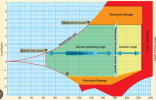
You'll observe that at speeds below Va ("maneuvering speed"), the stall occurs before g's are high enough to damage the plane. Above Va, you can do damage.
Clip4
Touchdown! Greaser!
Only if you move a single flight control, in one direction only, in smooth air.Flat bottom airfoils are also common, but they have more drag than a convex lower surface.
It depends on the aircraft and how you load it. I haven't needed to do a full W&B on any of the airplanes I've owned over the last 40 years, as as long as I don't exceed the baggage weight limitation it won't be overweight or out of CG limits with any passenger or fuel load. However, these are all one or two seaters; with 4 seat airplanes you often have to trade passenger and/or baggage weight for fuel.
At Va or below the aircraft will stall before you can exceed the g limits. Above Va you need to be more careful.
Clip4
Touchdown! Greaser!
Your diagram is incomplete and Va is not a speed which at or below the pilot is allowed full unrestricted control surface movements without the danger of structural damage or failure.If I'm loading the plane in a similar way to what I've done (and calculated) previously, there's no need to do a new W&B. OTOH, my plane tends to be nose heavy, so when I'm loading up for a trip and maybe taking other people, I'll run a W&B with my planned take-off fuel and with zero fuel to make sure it stays within the envelope for the whole flight. If I'm fully loaded with people and bags, I won't be able to carry full fuel, so it's necessary to do the calculation to see how much fuel I can take.
Study this diagram:
You'll observe that at speeds below Va ("maneuvering speed"), the stall occurs before g's are high enough to damage the plane. Above Va, you can do damage.
Rolling and pulling at the same time can be your last act as a pilot.

- Joined
- Apr 18, 2013
- Messages
- 5,322
- Location
- The independent worm saloon
- Display Name
- Mantis Toboggan, MD
The Va everyone is talking about so far in this thread varies with weight (decreases as weight decreases), while the design maneuvering airspeed, also known as Va, is only valid at gross weight.
Also keep in mind that both definitions of Va say nothing about the effects and/or survivability of a high energy departure from controlled flight if you do manage to stall at just below your g-limit.
Nauga,
tucking and rolling
Also keep in mind that both definitions of Va say nothing about the effects and/or survivability of a high energy departure from controlled flight if you do manage to stall at just below your g-limit.
Nauga,
tucking and rolling

- Joined
- Jun 7, 2008
- Messages
- 16,742
- Location
- DXO124009
- Display Name
- Light and Sporty Guy
- Home Airfield
- ONZ
Nope.Why do wings have a lower camber? Wouldn’t that just decrease the pressure differential between the top and bottom?
- Joined
- May 15, 2020
- Messages
- 7,764
- Display Name
- Ernie
- Home Airfield
- C81
Well, this wouldn't be poa without semantics. But wouldn't that be at MAX gross weight? Gross weight would be just what it weighs currently.while the design maneuvering airspeed, also known as Va, is only valid at gross weight.
Also keep in mind that both definitions of Va say nothing about the effects and/or survivability of a high energy departure from controlled flight if you do manage to stall at just below your g-limit.
Nauga,
tucking and rolling
- Joined
- Apr 18, 2013
- Messages
- 5,322
- Location
- The independent worm saloon
- Display Name
- Mantis Toboggan, MD
But wouldn't that be at MAX gross weight? Gross weight would be just what it weighs currently.
Busted! I'll dust off my pedantry hat and correct us both, it's valid only at "design weight." That's almost certainly going to be max gross, but maybe not always, especially with STCs that increase max gross.
Nauga,
maxed out
So can you damage the airplane in the example of a stall and hard pull back? Even though it’s a single control in one direction, and you’re well below Va? What about in banked turns? How does that affect it?The Va everyone is talking about so far in this thread varies with weight (decreases as weight decreases), while the design maneuvering airspeed, also known as Va, is only valid at gross weight.
Also keep in mind that both definitions of Va say nothing about the effects and/or survivability of a high energy departure from controlled flight if you do manage to stall at just below your g-limit.
Nauga,
tucking and rolling

flyingcheesehead
Taxi to Parking
- Joined
- Feb 23, 2005
- Messages
- 28,184
- Location
- UQACY, WI
- Display Name
- iMooniac
- Home Airfield
- KUES/KMKE
Only if you move a single flight control, in one direction only, in smooth air.

American Airlines Flight 587 - Wikipedia
- Joined
- Apr 18, 2013
- Messages
- 5,322
- Location
- The independent worm saloon
- Display Name
- Mantis Toboggan, MD
Following this crash Part 23.441 was changed to require a 50% overshoot in steady-state achievable sideslip angle at Va as part of the loads analysis required.American Airlines Flight 587 - Wikipedia
en.wikipedia.org
Not the reversals as occurred on AA587 but acknowledgement that it's a dynamic condition with higher loads than were previously required for cert.
Nauga,
and the pedal pushers

Pinecone
Final Approach
Where Va won't break the plane falls apart is rolling G.
That chart shown applies to JUST pitch. If you are rolling, the two wings are at different loads. If you pitch and roll the upgoing wing (upright flight) is loaded from rolling and loaded from the pitch, the combination can be over the load limit and break the plane.
That chart shown applies to JUST pitch. If you are rolling, the two wings are at different loads. If you pitch and roll the upgoing wing (upright flight) is loaded from rolling and loaded from the pitch, the combination can be over the load limit and break the plane.