172 Approach Speed

So book knowledge is not important?

Actually, not as much as you think. The "book" gives you various V speeds you should adhere to stay safe. They give you boundaries to operate within not hard and fast rules to apply.

This is particularly true when it comes to landing: You need to KNOW HOW TO LAND and adapt to different speeds. Your cite picture is a big part of that process.

A correct cite picture allows you to adjust to different wind conditions which will result in a good to great landing.
 
Last edited:
Actually, not as much as you think. The "book" gives you various V speeds you should adhere to stay safe. They give you boundaries to operate within not hard and fast rules to apply.

That's not the kind of book knowledge I'm talking about.
 
I am a student pilot, so please excuse my ignorance.

The Airplane Flying Handbook repeatedly says that you should fly final approach at 1.3 x Vs0. Vs0 in the 172R I am mostly flying is 33 kts. 1.3 times that is 43 kts. Nobody flies the approach that slowly in the 172, and I have been instructed to fly it at 65 kts, which works well.

Can someone explain the discrepancy to me? Does the 1.3 x Vs0 formula just not apply to a 172?

Thanks in advance.
Our old F-model had an approach speed of 60-65 mph! If you came in at 60, you'd better be riding the throttle, because you could develop an amazing sink rate, and it was quite a yank to keep that front wheel off the deck. Even 65 mph made a huge difference. And 120 mph over the numbers would let you float for a few thousand feet.
 
I am not allowed to post links here, but reference this manual:

https://www.se.edu/aviation/wp-content/uploads/sites/4/2020/10/172R-POH.pdf

Pages 2-5 and 5-12 both lists Vs0 for the 172R as 33 kts. If I am reading it wrong, someone please tell me.

Also, as I indicated in the OP, I am flying stable approaches at 65 kts just fine. The point of this thread is to understand the theory and why the 1.3 formula doesn't seem to apply.
Yes I know this is an old thread -

Notice the "FOR TRAINING PURPOSES ONLY" watermark. Anything marked with this is only to be used for training concepts. It is NOT to be used as a source of information for the plane you are flying, nor is it to be used for any sort of flight planning.
 
Last edited:
Yes I know this is an old threat -

Notice the "FOR TRAINING PURPOSES ONLY" watermark. Anything marked with this is only to be used for training concepts. It is NOT to be used as a source of information for the plane you are flying, nor is it to be used for any sort of flight planning.
It's not about the watermark.

Watermarked or not, unless it is the original serial-numbered POH for that specific airplane, including all of the applicable supplements (or an exact duplicate), it's not official and technically informational only.
 
It's not about the watermark.

Watermarked or not, unless it is the original serial-numbered POH for that specific airplane, including all of the applicable supplements (or an exact duplicate), it's not official and technically informational only.
But I would also note that if it is for the same model and/or serial number range, it’s information that is valid for flight planning or aircraft-specific information, provided there aren’t mods that supercede the basic POH.
 
Last edited:
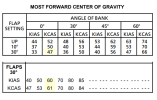
VSO is the calibrated power-off stall speed or minimum steady flight speed in the landing configuration (flaps extended, gear down). 1.3 x VSO in a 172 is 62 KIAS. The difference between IAS and CAS with 30° flaps at 62 knots is +/- 1 knot.
I don't think @Gray Ghost is till with us but, if they are, here's the stall speed table from a 172R showing a 47 KCAS Vs0. 1.3 Vs0 is 61.1 KCAS. As you point out the Calibration Chart shows a 1 KT difference - 62 as you said.

1774288782404.png
 
Back
Top